Course Introduction

The quality of your attention determines what you can know.

This is not a wellness statement. It is an epistemological one. Everything else in this curriculum uses this instrument. This course is about learning what it is and how to use it.

The Boop · Course Thesis

Attention is not concentration. It's what happens when you stop deciding what you're going to find.

ATTN-100 · The Instrument

About This Course

The Caveat — Stated Upfront

Attention is hard right now. Not because you lack discipline. Because your nervous system learned to allocate its resources to survival, and open receptivity is not a survival posture. An attention economy was built by people who understood exactly what they were doing. And some of what makes attention hard predates your phone — it lives in your body and has a history. This course knows what it's up against.

Moby philosopher

On Reporting

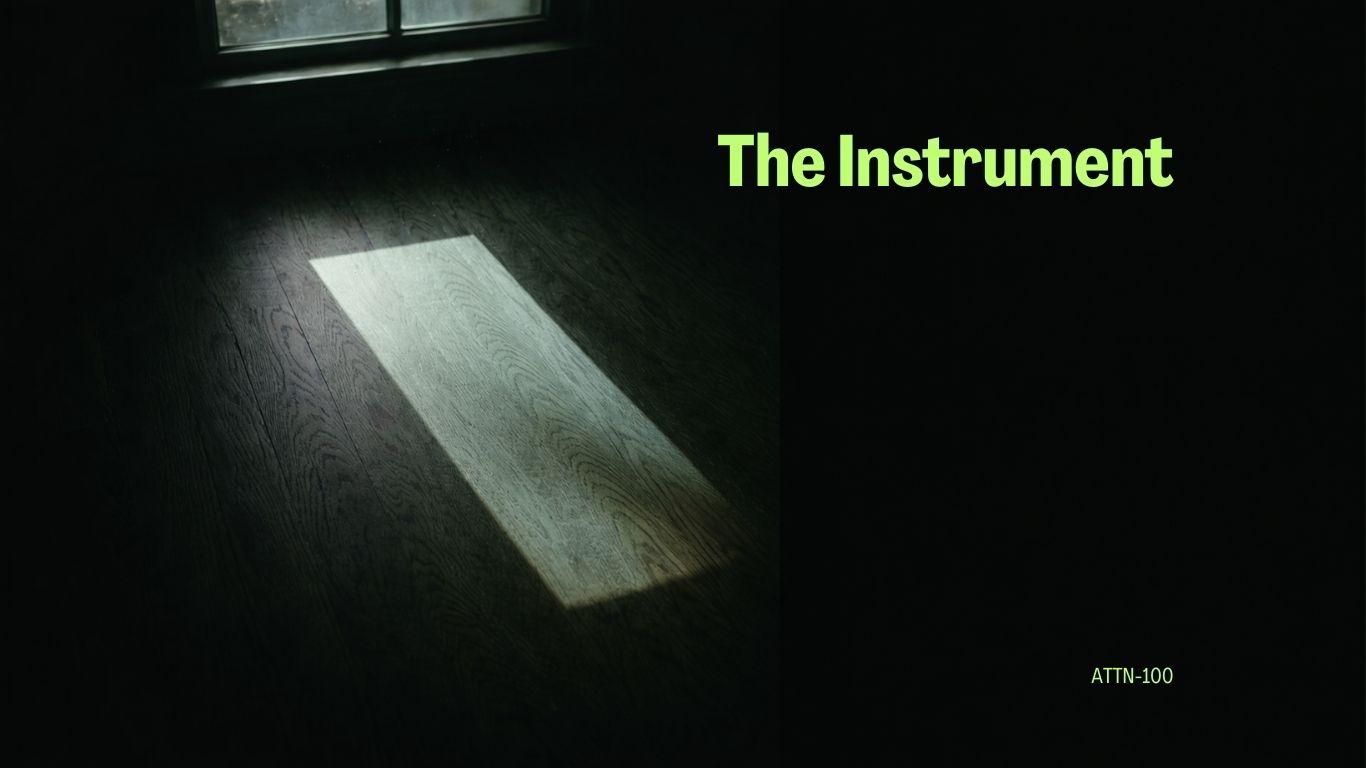
"It was beautiful" is interpretation. "The light came through the left window at about 4pm and made a parallelogram on the floor that I kept expecting to be rectangular" is a report. The distinction is the course.

Moby boop marigold feet

Attention is not a single thing. It is a family of practices — outward and inward, receptive and focused, toward the world and toward the self. This course works through all of them, in that order, because outward observation is the more checkable of the two. The inward instrument has nothing outside itself to confirm against. That is what makes it harder, less verifiable, and more necessary.

Syllabus

UNIT I What Happened? 5 sessions
1
A Practice. No Explanation.
Practice: draw / listen / sit with one object
A practice. No explanation. Pick one: draw something in the room for 20 minutes, sit outside and describe exactly what you hear, or spend 10 minutes with one object. Write down what happened. Don't explain it. Report it.
On reporting: "It was beautiful" is interpretation. "The light came through the left window at about 4pm and made a parallelogram on the floor that I kept expecting to be rectangular" is a report. The distinction is the course.
2
What Attention Is
Anchor: James, Principles of Psychology, Ch. on Attention Practice: one paragraph on something walked past unseen
James — what attention is and why it's educable. "The faculty of voluntarily bringing back a wandering attention is the very root of judgment, character, and will." The claim arrives to explain something already experienced. Reporting standard named explicitly: report, not analyze. Most prior education trained the opposite. That's the first thing to notice.
3
The Attention Economy
Practice: one hour without a screen
External capture. What your phone is doing and why. The specific mechanisms designed to fragment and redirect attention. This is something done to you from outside.
4
The Nervous System as History
Anchor: Menakem, My Grandmother's Hands, selected Practice: notice once when your body shifted before your mind did
Menakem — structurally different from session 3: external capture is done to you from outside. This lives in you and predates your phone. "Your body is where your ancestors' unmetabolized pain lives." Not personal failure. Adaptive response.
5
Consolidation
Practice: report on yourself — what fired, what you avoided
What do you now understand about your own attention that you didn't before session 1? Not a summary of the readings — a report on yourself. What fired? What did you avoid? Where did you find it easy to pay attention and where did you find it impossible? This session lands the unit before the practices begin.
UNIT II The Outward Instrument 6 sessions
6
Practitioners
Reading: Kimmerer · Muir · Dillard · Berry
What sustained outward attention looks like in practitioners who developed it over time. Writing as a tool that forces a second look — not self-expression, but description that demands re-seeing. This is what you're about to try.
7
Drawing
Practice: draw something in the room
The hand accountable to the eye. You cannot draw what you think you see — only what you actually see. The gap between the two is the lesson. No prior drawing skill required. The inability to draw what you see is the data.
8
Field Observation
Practice: go somewhere specific and describe exactly what is there
Go somewhere specific. Describe exactly what is there, not what you expect. Write it — not to produce a report, but because writing makes you look again.
9
Close Reading of a Physical Object
Practice: hold one object for five minutes
Not a text — a thing. Hold it. Describe it fully. What do you notice on the fifth minute that you missed in the first?
10
Ensemble Listening
Listening: ensemble recordings selected for group attention Practice: listen for the group, not the melody
Listen for the group, not the melody. What do you hear when you stop following the obvious thing? What changes when your attention is accountable to a whole rather than a part?
11
Conversational Listening
Reading: Rogers (active listening) · O'Reilley · Terkel
Rogers on active listening. The Quaker practice of "listening someone into speech" (O'Reilley). Studs Terkel as practitioner. The specific attention required to hear what someone is actually saying rather than what you expect, what confirms your model, or what you're already formulating your response to.
UNIT III The Inward Instrument 4 sessions
12
Contemplative Sitting
Anchor: Weil, "Attention and Will" (Gravity & Grace) Practice: sit and notice what fires
Weil on attention without agenda. Not relaxation — precision. The specific practice of noticing what fires in you, what you avoid, what you reach for. The inward instrument is not introspection. It's watching your own noise without becoming it.
Outward practices are accountable to something outside you. Inward practice has nothing to check against but itself — which is harder, less verifiable, and more necessary.
13
Body Scan as Attention Practice
Anchor: Menakem, returned as practice (not argument) Practice: attend to a body that is bracing
Session 4 explained why your body braces. This session asks: what does it feel like to bring attention to a body that is bracing — not to fix it, but to know what's there. Menakem returns here not as argument but as practice.
14
Journaling as Attention Practice
Practice: the field journal turned inward
Distinct from self-expression. The field journal turned inward. Not therapy. Not venting. Tracking. What do you notice about your own noticing?
15
Return
Anchor: Scarry, On Beauty and Being Just Practice: Session 1 prompt, again
We return briefly to conversational listening. What do you hear now that you couldn't before you knew your own noise? Scarry: the decentering of self that attention produces. You cannot fully hear another person while you are still the reference point. Then: return to Session 1's original practice. Same prompt. Write what happened. The difference between that report and the one you wrote in Session 1 is the course. No summary needed.

How This Course Connects

ATTN-100 is Ring 0 because the instrument it develops is used in every course that follows. Start here or don't. If you start here, the rest lands differently.

Assessment

Per Session

Boop Log

One entry per session. Report, not analysis. What did you notice?

Per Unit

Unit Response

One practice, one observation. Two pages max. The thing that landed, followed all the way down.

Session 15

Return

Same prompt as Session 1. Informal. Kept by the student. Not submitted, not graded.

3 Units

Certificate of Completion

Complete all three units and you've finished the course. A certificate is issued.

Mobocoin Ledger

Mobocoin
Earn MC for completing this course.
Learn how Mobocoin works →
Boop logs (15 sessions)+15 MC
Unit responses (3 units)+6 MC
Course completion+5 MC
Total Available 26 MC
Faculty

Character TBD. Persona: someone whose professional life is structured around the gap between what people think they see and what's actually there. Not a therapist, not a meditation teacher, not an academic. Drily funny about human perceptual failure. Practices what they teach. Name and character built in the faculty pass after Ring 0 is designed.

— Faculty TBD · Institute for Attention and Perception