Course Introduction
You can perceive clearly and still reason badly.
Careful observation is the prerequisite for careful thinking. It is not the same thing. This course is about what comes next: how to move from what you noticed to what follows, how to tell the difference between an argument that works and one that merely feels convincing, and how language — the tool you think with — is also the primary instrument used to think for you.
The Boop · Course Thesis
An argument is not what you have when you're winning. It's a structure you can examine whether you're winning or not.
PHIL-110 · Critical Thinking & Argumentation
About This Course
Most people think they are thinking when they are actually feeling, and think they are reasoning when they are actually pattern-matching to what they already believe. This is not a character flaw. It is the ordinary condition of human cognition. The problem is that the world has figured out how to exploit it at scale.
This course gives you three things. First, a working vocabulary for argument structure: what an argument actually is, how to find it, how to evaluate whether it holds together. Second, a framework for evidence: what kinds count, what they can and can't establish, and where the gap between data and conclusion is being quietly papered over. Third, an honest account of language: how framing shapes conclusions before you've started thinking, how definitions do argumentative work without announcing it, and how you can be rhetorically captured by your own side as thoroughly as by anyone else's.
The goal is not to make you unpersuadable. Persuasion is how things change. The goal is to make you persuadable for better reasons.
It is not enough to have a good mind. The main thing is to use it well.
— René Descartes, Discourse on the Method, 1637
A Note on This Course
Logic won't save you. Being right about the structure of an argument does not mean you'll act on it, persuade anyone with it, or survive the social cost of holding it. This course will make you harder to manipulate and more aware of how often you manipulate yourself. That is not the same as making things easier. It may make some things harder. The goal is not comfort. Clarity, in a world that profits from confusion, is a form of resistance.
The tools here are not new. Aristotle wrote about rhetoric. Weston's rulebook has been in print for decades. Lakoff has been explaining framing since the nineties. None of it is secret. What's missing, usually, is the moment when someone sits down and says: here is how this works, here is where you are vulnerable, here is what to do about it. That is what this course is trying to be.
The Seam: Navigating the Sequence
If you completed The Instrument, you were trained to report before you analyze — to stay with what's there before you build meaning from it. That discipline was real and it still applies. This course asks you to do something that may feel like a contradiction: now analyze. The contradiction is only apparent. Report first is a preparation posture. It ensures you're working with what's actually there before you start reasoning. PHIL-110 is what you do once you've reported. The sequence is not report instead of analyze. It's report so that when you analyze, you're analyzing what's real. Session 2 names this explicitly.
Three Threads
Structure: What an argument is and how to find one. Premises, conclusions, validity, soundness, inductive and deductive reasoning, and the fallacies worth knowing. This thread asks: does this argument hold together, independent of whether I agree with it?
Evidence: What counts as evidence, what it can establish, and where the gap between data and conclusion is being quietly crossed. Correlation, causation, source credibility, statistical sleight of hand, and the inference gap. This thread asks: what would actually establish this claim?
Language: How framing shapes conclusions before you start thinking, how definitions do argumentative work without announcing it, and how rhetorical capture works on all sides. This thread asks: what is the language doing, and am I the one doing it?
Syllabus
1
A Practice. No Explanation.
Practice: three texts, one paragraph
You are given three short texts: a newspaper op-ed, a paragraph from an advertisement, and a paragraph from a scientific abstract. No instructions except read them. Then write about what you noticed. Not what you thought of them. Not whether you agreed. What you noticed. What stood out. What seemed to be doing something. Session 2 names what you were encountering.
2
What an Argument Is
Structure: Weston, A Rulebook for Arguments, Rules 1–9
Practice: map the three Session 1 texts
Not a fight. Not a position. A structure. Premises that support a conclusion. The difference between a claim and an argument. The difference between an argument and an explanation. The difference between a persuasive text and a sound one. We return to Session 1's three texts and find what was doing the supporting — and what wasn't.
The seam is named here. If you came from The Instrument: "report, not analyze" was about perception. This course is about what you do after you've reported. The discipline doesn't end. It narrows. Report the argument before you evaluate it. Find the structure before you decide if it works.
3
Deductive and Inductive
Structure: Weston, Rules 10–22
Practice: map four arguments by type
The difference matters and most people blur it. A deductive argument guarantees its conclusion if its premises are true — or it doesn't, and then it's broken. An inductive argument gives you grounds, better or worse, for a conclusion that could still be wrong. Most real-world arguments are inductive. Most people evaluate them as if they were deductive, then get confused when certainty doesn't arrive. Practice: four arguments, structure mapped, type labeled. Not evaluated. Mapped.
4
Validity and Soundness
Structure: Weston, Rules 23–28
Practice: structure vs. content on live arguments
The hardest distinction in introductory logic because it cuts against intuition. A valid argument can have false premises. A sound argument is valid and has true premises. You can be right for the wrong reasons. You can be wrong despite impeccable structure. We take one political argument from each side of a visible contemporary debate and practice separating structure from content. Does the argument work as an argument, independent of whether you agree with it? Students will resist this. The resistance is the lesson.
5
Fallacies Worth Knowing
Reading: Sagan, "The Fine Art of Baloney Detection"
Practice: find one in the wild
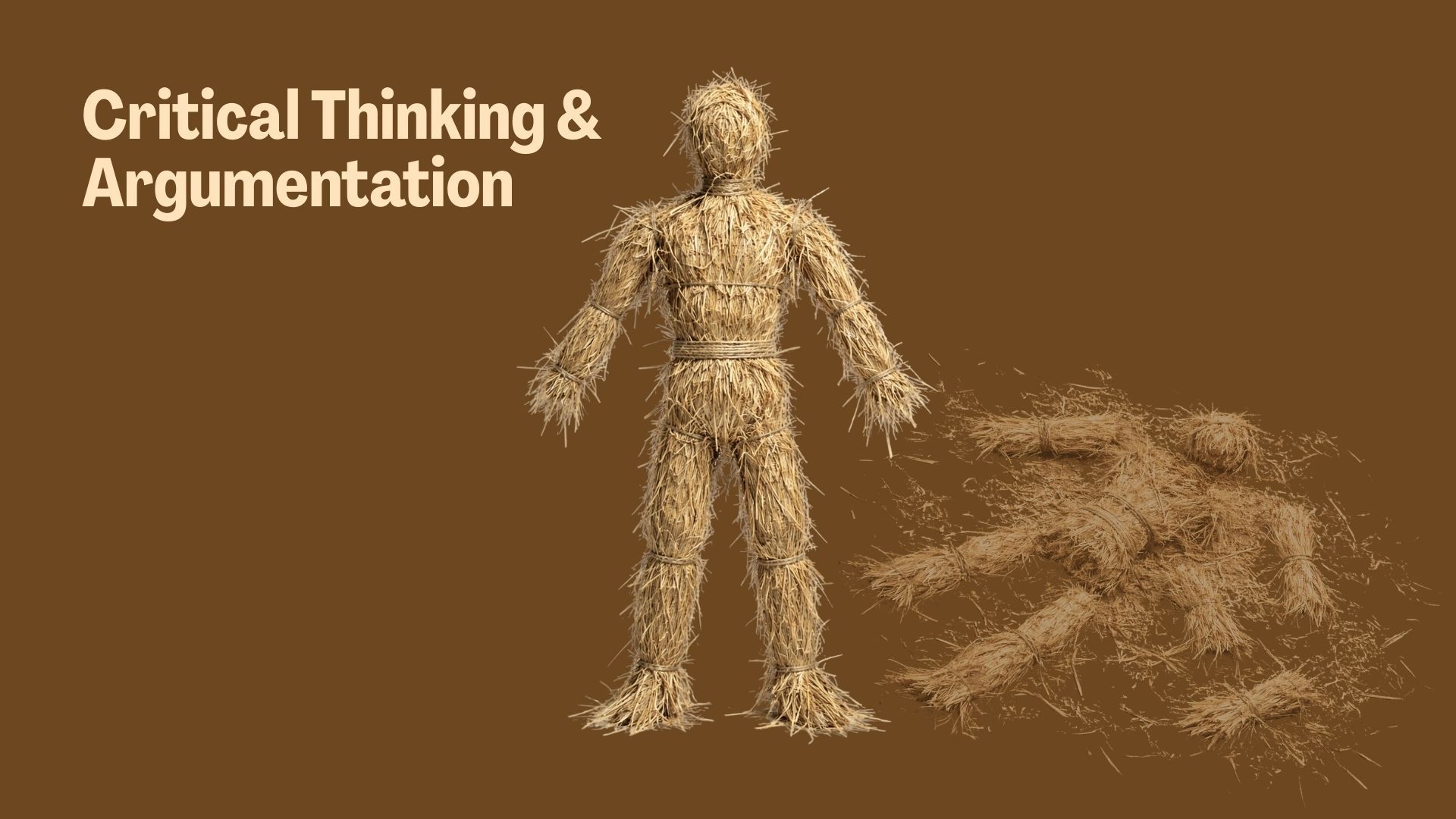
Not a comprehensive taxonomy — that is a waste of time and encourages gotcha thinking. Five fallacies that are genuinely common, genuinely seductive, and genuinely worth knowing: ad hominem, straw man, appeal to authority (when it works and when it doesn't), false dilemma, slippery slope (when it's a fallacy and when it isn't). Practice: find one in something you read or heard this week. Bring it as observation, not prosecution.
6
What Counts as Evidence
Evidence: Kahneman, Thinking, Fast and Slow, selected
Practice: audit one confident belief
Not everything that feels like evidence is evidence. Anecdote, testimony, correlation, causation, statistical significance, effect size — these are different things, and conflating them is the engine of most bad reasoning. The standard is not perfection but proportionality: your confidence in a conclusion should scale with the quality and quantity of evidence supporting it. Practice: take a belief you hold confidently. Ask what evidence actually supports it. Not what feels true. What would count as evidence. What evidence you actually have.
7
Sources and Credibility
Reading: Frankfurt, On Bullshit
Practice: trace a news story to its source
Expertise is real. Consensus is real. Credentials don't make someone right, but they shift the burden of proof. How to evaluate a source: track record, domain specificity, incentive structure, peer review, verifiability. The gap between primary sources and reporting of them. How information degrades. How headlines lie by omission. Frankfurt's short book earns its place here: the distinction between lying and bullshitting is not academic.
8
Correlation and Causation
Evidence: Huff, How to Lie with Statistics, selected
Practice: find a causal claim in the wild
The classic, still necessary. Why our brains infer causation from correlation — it's efficient, usually right, and wildly exploitable. Confounding variables. Reverse causation. The controlled trial as epistemological achievement, and its limits. This session does not end in skepticism about all knowledge. It ends in calibration: some inferences are better than others, and knowing why matters.
9
The Inference Gap
Evidence: Kahneman, continued
Practice: map every inference in one argument
The distance between what evidence shows and what the conclusion claims. Most bad arguments don't fail at the evidence level. They fail in the leap. "Studies show X correlates with Y, therefore you should do Z." Unpacking that sentence is nearly a complete course in critical thinking by itself. Extended practice: students receive a full three-paragraph argument and map every inference in it. Not to evaluate it. To find every place the text moves from one claim to another and name what the move is.
10
The World That Lies
Evidence: Huff, continued
Practice: find one technically-accurate-but-misleading example
Not a session about lying. A session about structural misrepresentation. Statistics that are technically accurate and deeply misleading. Graphs with manipulated axes. Definitions that beg the question. Framing that pre-decides the conclusion. The point is not that everyone is trying to deceive you. The point is that the infrastructure of public communication is built to do work, and some of that work is moving you toward a conclusion before you notice you're being moved.
11
Framing
Language: Lakoff, Don't Think of an Elephant, Ch. 1–4
Practice: rewrite one headline five ways
Language shapes thought. This is not a metaphor. The words available to you constrain the distinctions you can make. The frame of a question pre-loads the answer. "Are you in favor of tax relief?" versus "Are you in favor of reducing public investment?" — same policy, different conclusions, depending on which version you were asked. There is no neutral frame. There is only the frame you notice and the one you don't.
12
Definitions as Argument
Language: Lakoff, Ch. 5–8
Practice: find a debate hidden inside a definition
To define a term is to take a position — often before the argument has started. Many political arguments that seem to be about evidence are actually arguments about definitions, and participants don't know it. Spotting definitional disputes is a skill. Resolving them requires a different kind of reasoning than evaluating evidence. Practice: identify one ongoing public debate where the parties are using the same word to mean different things. What would happen if they agreed on a definition?
13
Rhetoric
Language: Aristotle, Rhetoric, Book I, selections
Practice: analyze one speech or ad by mode
The art of persuasion, and why you need to understand it even if you never intend to use it. Aristotle's three modes: ethos (credibility), pathos (emotion), logos (reason). Good rhetoric uses all three. Bad rhetoric substitutes two of them for the third. Being moved by something is not evidence that it's true. The distinction between persuasion and manipulation is not always clean, but it is real. Manipulation bypasses your capacity to evaluate. Persuasion presents itself for evaluation.
14
Rhetorical Capture
Language: Stanley, How Fascism Works, selected
Practice: audit three words in your own regular usage
What happens when the language of a movement colonizes your thinking before you've decided to join the movement. You can be captured by language from your own side as thoroughly as by anyone else's. The test is not: do I agree with the conclusion? The test is: am I reaching the conclusion by thinking, or by resonance? Practice: identify three words or phrases in your own regular usage that carry more argumentative weight than you've examined. What exactly do they mean? What do they assume?
15
Return
Practice: the three texts from Session 1
Same three texts from Session 1. Same instruction: read them. Write about what you notice. No summary. No demonstration of coverage. Then one informal question, kept by the student and not submitted: what argument have you been making your whole life that you've never examined? You don't have to answer it now. Just write it down. The gap between Session 1 and this one is the course.
How This Course Connects
PHIL-110 is the third course in Ring 0. The Instrument develops the perceiving instrument. COGN-120 explains why that instrument fails. PHIL-110 teaches you how to reason well despite that failure. The language thread in Unit III connects directly to AMST-210 and any course that asks how power uses words. The evidence thread runs alongside anything in Ring 1 that involves research or data.
Assessment
On Using AI Well · And Not Instead
The right use of AI in this course is as a sparring partner: test your argument against it, push back on its objections, ask it to steelman the position you're rejecting. That's using a tool to think harder. Using it to generate your responses removes the struggle — which is precisely where the thinking happens. This course is about noticing when reasoning is being done for you. Consider carefully what it would mean to outsource that to a language model, in this particular course, right now.
Per Session
Boop Logs
One entry per session. What did you notice? Where did you encounter it outside the session? No summary. No recap. A report. Length is yours to determine.
Per Unit
Unit Response
One argument that landed. What it was. What it did. What you see in it that you wouldn't have seen before this unit. Two pages. Not a survey — one thing, followed all the way down.
Unit Complete
Your Avatar Advances
Finish the boop logs and unit response and you're through it. No partial credit. No grade. You did it or you didn't.
3 Units
Certificate of Completion
Complete all three units and you've finished the course. A certificate is issued. Moby has approved this. He was watching the whole time.
Mobocoin Ledger
Boop logs (15 sessions)+15 MC
Unit responses (3 units)+6 MC
Course completion+5 MC
Total Available
26 MC
A Note on This Course
We built this course because we kept noticing that people who were paying close attention to the world were still being fooled. Not by obvious lies. By structure. By framing. By arguments that felt airtight because no one had ever taught them what airtight actually means.
— Faculty TBD