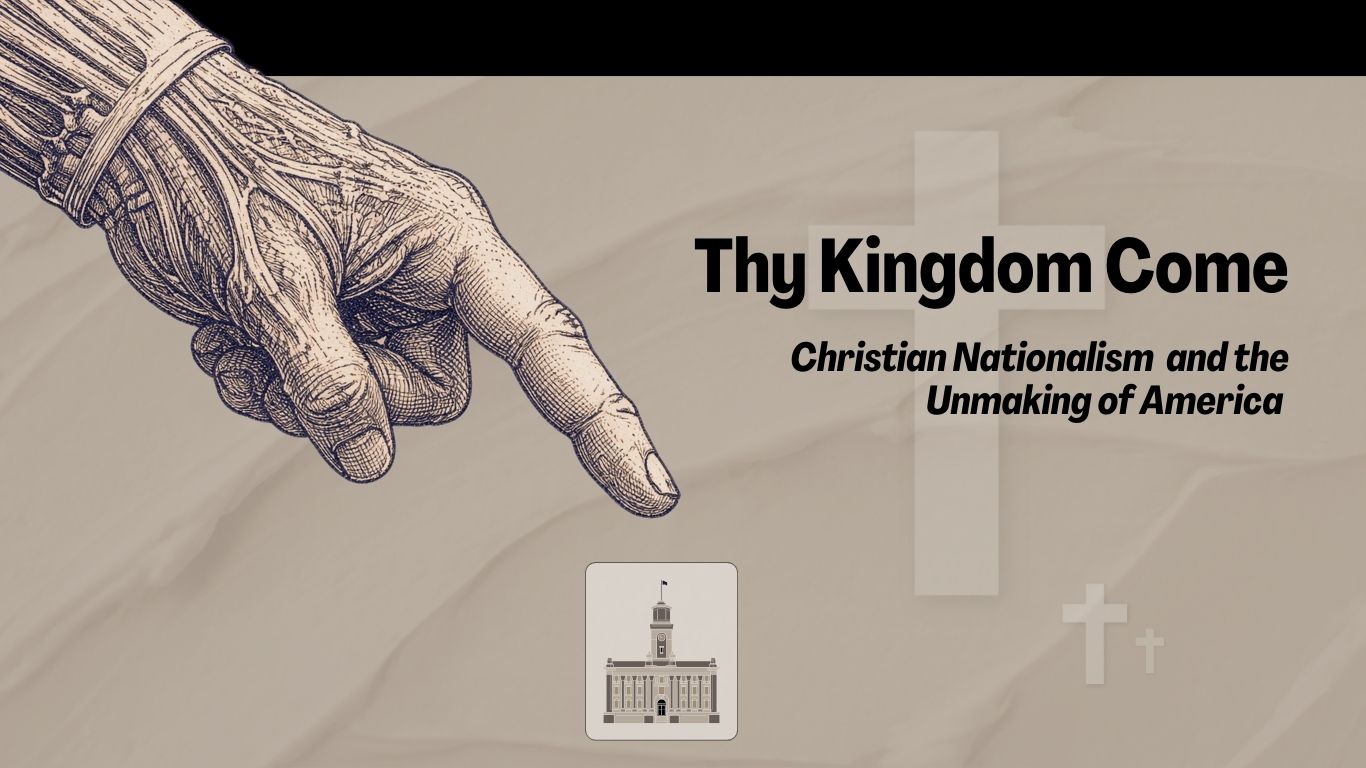
Course Introduction
This is not a course about religion. It is a course about power wearing religion's clothes.
Christian nationalism did not emerge from a pew. It was built in boardrooms, law schools, and donor networks over decades — patient, systematic, and largely invisible to the people it was designed to reshape. This course asks how that happened, what it wants, and what it has already done. The answers are in the documents, the money, and the theology. We will read all three.
Boop University · Course Thesis
Christian nationalism is not a spiritual movement that became political. It is a political movement that has always worn spiritual clothes. This political movement has been more organized, more patient, and more systematic than its opponents dared believe.
AMST-210 · Thy Kingdom Come
About This Course
Most Americans encounter Christian nationalism the way you encounter fog. You're in it before you know it has a name. This course gives it a name, a history, and a structure. We trace the movement from its theological roots through its institutional machinery to its present grip on law, politics, and the body.
We read historians, journalists, and insiders. We watch documentaries that follow the money. Two specific voices anchor the witness thread: a researcher who spent years mapping autocracy's preconditions and found them at home, and a former insider who got out and has been explaining what she saw ever since. The goal is not to make you angry, though you may become angry. The goal is to make you literate — able to recognize the language, trace the network, and understand what is being built and why.
Andra Watkins, the former insider whose Substack runs through the course as a live primary source, names the mechanism this way: "When people turn faith into certainty, they cannot countenance being wrong." That distinction — faith versus certainty — is the spine of Unit I.
The course is organized around four threads that cut across all three units: Theology (the belief system that powers the movement), Institution (the organizations, money, and law that sustain it), Body (gender, reproduction, and sexuality as sites of control), and Witness (what it looks and feels like from the inside of a country being remade).
A Note from Prof. Blenany
I want to be clear about what this course is not. It isn't an argument against Christianity or a brief for any political party. It is an attempt to understand a specific, organized, well-funded movement that has spent fifty years working to reshape American institutions — and has largely succeeded. You can be a person of deep faith and find this movement as alarming as anyone. Several of the best writers on this subject are.
Four Threads
Theology: The belief system itself — eschatology, dominionism, biblical inerrancy, and how doctrine becomes policy. This thread asks what Christian nationalists actually believe and why those beliefs make political action not just permitted but required.
Institution: The organizations, donor networks, legal organizations, and media empires that convert belief into power. The Council for National Policy. The Federalist Society. The Fellowship. Leonard Leo. Follow the money, find the machine.
Body: Gender, reproduction, sexuality, and family structure as the primary sites where Christian nationalist control is exercised and enforced. The body is where abstract theology becomes concrete law.
Witness: What it looks and feels like from inside — the insider who got out, the journalist watching democracy erode through a car window, the researcher who saw it coming and said so. This thread insists that analysis alone is not enough.
Syllabus
1
What Is Christian Nationalism?
Watkins: "What Is a Christian Nationalist?" (Substack)
Du Mez: Jesus and John Wayne, Introduction
We begin with a definition problem. "Christian nationalist" means something specific — and something its adherents often deny. Watkins and Du Mez together give you the vocabulary to see past the denial.
2
Scripture as Political Document
Watkins: "Christian Nationalists: God Said It, and That Settles It" (Substack)
Du Mez: Ch. 1–3
Biblical inerrancy is not a theological position. It is a political one. Once the text is infallible, whoever controls the interpretation controls everything downstream.
3
The Masculinity Doctrine
Du Mez: Ch. 4–7 (core)
Watkins: "Christian Nationalism: Men Work; Women Mother" (Substack)
Du Mez's central argument: evangelical Christianity did not produce Donald Trump despite its values. It produced him because of them. The militant masculinity was always there.
4
Certainty vs. Faith
Watkins: "The End of the World as We Know It" (Substack, March 2026)
Kendzior: Hiding in Plain Sight, Ch. 1–2
This is the session that names the mechanism. Faith tolerates uncertainty. Certainty cannot. When a movement operates on certainty — about texts, about end times, about who belongs — it licenses anything.
5
The Long Formation
Du Mez: Ch. 8–10
Watkins: "The Three Sects of Christian Nationalism" (Substack)
Write: Where did you first encounter this language?
Christian nationalism did not emerge in 2016. By the time most Americans noticed it, it had been building for forty years. This session maps the formation.
Unit I Checkpoint
Christian nationalism presents itself as a return to origins. Identify one claim from this unit where the historical record contradicts the movement's own founding myth. Be specific: what does the movement claim, what does the record show, and where does the gap appear first?
6
Follow the Money
Stewart: The Power Worshippers, Ch. 1–4
Watkins: "How Christian Nationalists Use YOU to Enrich Their Eternities" (Substack)
Stewart's book begins where the theology ends: with the donor networks, the dark money, and the organizations that convert belief into institutional power. Follow the money.
7
The Network: The Fellowship
The Family — Netflix docuseries, episodes 1–2
Stewart: Ch. 5–7
The Fellowship operates through prayer breakfasts and private relationships with heads of state. It isn't a secret. It's just rarely discussed by the people inside it.
8
Schools, Media, and the Long Game
Stewart: Ch. 8–10
Watkins: "The Phoenix Declaration" series (Substack)
Christian nationalist infrastructure includes thousands of schools, a parallel media ecosystem, and a legal pipeline designed to seed the judiciary for generations. This is the long game, and it has been running for decades.
9
The Legal Strategy: Leonard Leo and the Courts
Stewart: Ch. 11–12
Watkins: "Fight Back Against Leonard Leo's Attempt to Dominate Entertainment" (Substack)
The Federalist Society pipeline to the Supreme Court was not an accident. It was a forty-year project. Katherine Stewart traces it from the donor meetings to the confirmation hearings.
10
Bad Faith — Screening Session
Film: Bad Faith (2024) — full documentary
Note: Katherine Stewart appears — you've read her. Now watch her.
One of the ten best films of 2024. Watch it as a unit synthesis — everything from Unit II is in here: the Council for National Policy, the money, the Republican capture.
Unit II Checkpoint
Follow one institutional thread from this unit — legal, financial, or media — forward to a current event. Where does the machinery show up in something you encountered this week, in the news or in your own life? Name the institution, name the mechanism, name the moment.
11
The Body as Battleground
Watkins: gender and reproduction series (Substack, selected)
Kendzior: Hiding in Plain Sight, Ch. 3–5
Abortion, contraception, gender roles, sexuality — these are not social issues that Christian nationalism happens to care about. They are the primary sites where the movement exercises and enforces control. The body is the policy.
12
Democracy's Erosion in Real Time
Kendzior: Hiding in Plain Sight, Ch. 6–8
Watkins: "How Christian Nationalists Destroyed Democracy" (Substack)
Kendzior was writing about democratic erosion before most political scientists took it seriously as a domestic concern. This session asks: what did she see, when did she see it, and what does it mean that she was right?
13
The International Reach
The Family — Netflix docuseries, episodes 3–5
Watkins: "Christian Nationalism Global" series (Substack)
Christian nationalism is not an American export. It is an international network with American leadership. The Family's connections to Uganda, Brazil, and Eastern Europe are not peripheral — they are the model.
14
Resistance and Counter-Movements
Alberta: The Kingdom, the Power, and the Glory, selected chapters
Kendzior: Hiding in Plain Sight, final chapters
Watkins: "Purposeful Disengagement" series (Substack)
Tim Alberta writes from inside evangelical Christianity — his own faith, his father's church, the communities being torn apart. This session asks what resistance looks like when it comes from within.
15
Return to Start: What Is Christian Nationalism?
Watkins: "Every End Is a Beginning" (Substack) — optional
Write: the definition you would give a friend who just asked
We opened this course with a definition problem. We return to it now. Write the definition you would give a friend who just asked — in plain language, in one paragraph, without jargon. Then write one sentence about what you can say now that you couldn't say in Session 1. That sentence is the course.
The difference between the answer you would have given before Session 1 and the answer you write now — that gap is what literacy feels like.
Unit III Checkpoint
Based on what you've learned across all three units, write one paragraph each — three paragraphs total: what you think is most likely to happen next, what you think is most dangerous and underestimated, and what you think is most overlooked in mainstream accounts of the movement. Be specific. Vague pessimism is not analysis.
How This Course Connects
AMST-210 sits at the intersection of political history, institutional analysis, and American cultural studies. The power and institutional threads run directly into POLS-101. The belief and ethics threads connect to PHIL-110. The narrative failure visible throughout links to SB-1971 and ERTH-201 Unit III. The systems and collapse framing connects to APMA-115 and SB-1972.
Buy From a Real Bookstore
Every text on this syllabus is available through Bookshop.org, which sends a cut to an independent bookstore of your choice. Pick your shop. Support your neighborhood. Skip the algorithm.
Browse the List ↗
Assessment
A Note on Using AI to Do Your Work
This course asks you to sit with uncomfortable material and think carefully about power, belief, and language. Using a language model to generate your responses removes the discomfort, which is precisely where the thinking happens. The assignment is the struggle. A model cannot reckon with this for you. Keep it.
Per Session
Boop Logs
One paragraph per session. What did you recognize? Where did you see it outside the reading? No summary. No recap. Just: boop.
Per Unit
Unit Checkpoint
One specific response to the checkpoint prompt at the end of each unit. Two pages max. Your analysis, not summary. Due at the end of each unit.
Unit Complete
Your Avatar Advances
Finish the boop logs and unit checkpoint and you're through it. No partial credit. No grade. You did it or you didn't.
3 Units
Certificate of Completion
Complete all three units and you've finished the course. A certificate is issued. Moby has approved this. He was watching the whole time.
Mobocoin Ledger
Boop logs (15 sessions)+15 MC
Unit checkpoints (3 units)+6 MC
Course completion+5 MC
Total Available
26 MC
A Note on This Course
I built this course because I kept encountering people who were surprised. Surprised by the Supreme Court. Surprised by the legislation. Surprised by the language coming from the highest levels of government. And I kept thinking: the surprise is the problem. None of this was hidden. The documents existed. The networks were traceable. The theology was published.
The writers in this course — Du Mez, Stewart, Kendzior, Watkins — were not surprised. They had been reading the documents, mapping the networks, and saying what they saw for years. Some of them were dismissed. Some of them were called alarmist. They were not alarmist. They were early.
This course is an attempt to make you the kind of reader who is not surprised. Not because the future is predictable, but because the present is legible if you know what you're reading.
— Prof. SB