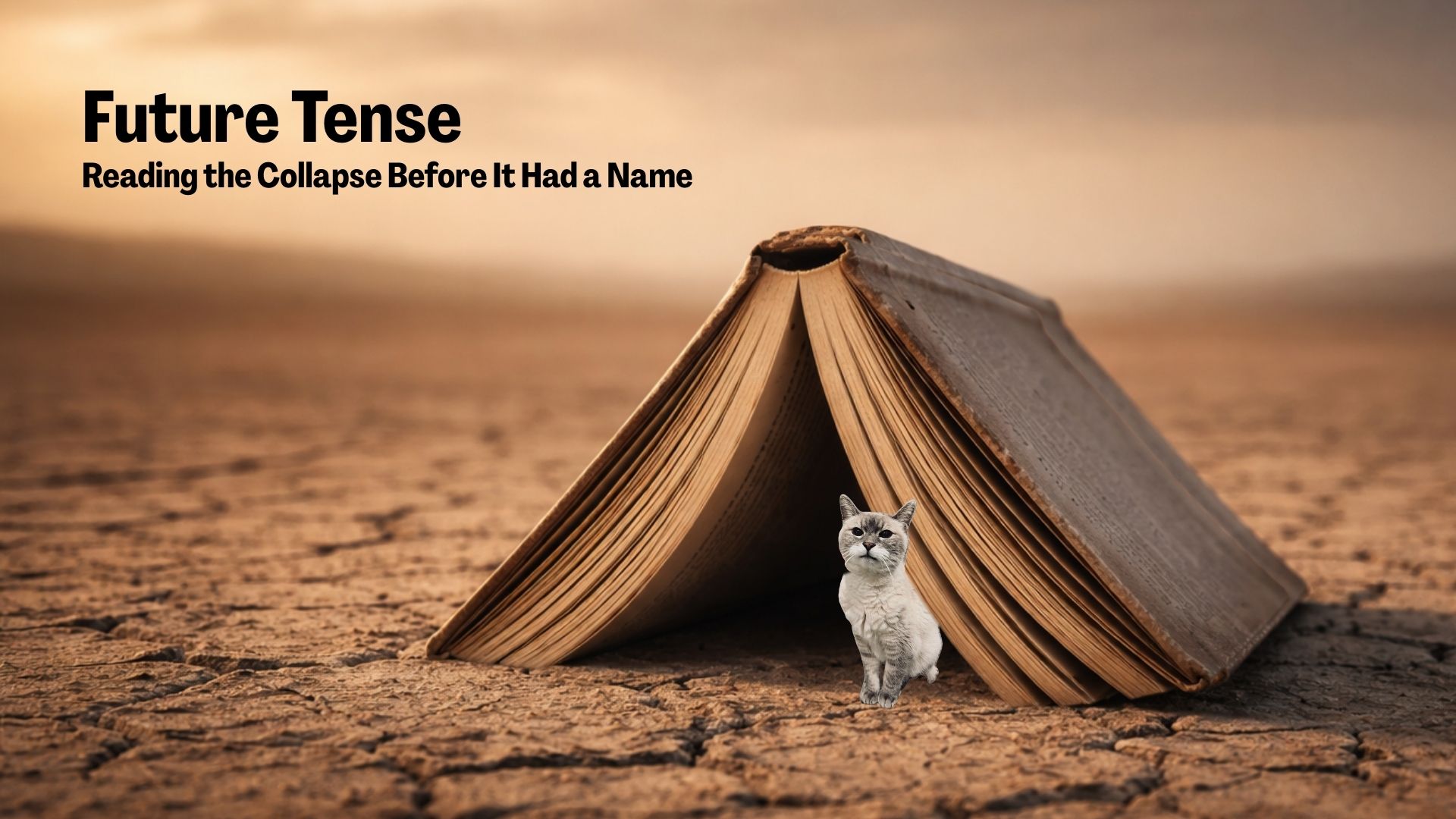
Course Introduction:
She wasn't predicting. She was modeling.
In 1993, Octavia Butler published Parable of the Sower. Open to any page. A charismatic American politician dismantling democratic norms with mass popular support. Communities gated and armed. Infrastructure failing faster than anyone admits. Climate making the coasts uninhabitable. She wrote it thirty years before it appeared on the front page.
When was this written? (1993.) What did she know that the economists didn't? The answer to that question is the whole course.
The Boop · Course Thesis:
Butler wasn't predicting. She was modeling. And the model still runs.
*boop* · there it is
About This Course
SB-1972 is the bridge course at BoopU: the place where literary analysis and systems science stop pretending they're different disciplines. We read Octavia Butler not as prophecy but as method — the sustained, rigorous act of modeling complex systems through narrative. We read Meadows and Tainter alongside her not to explain her, but to show that they're pointing at the same dynamics from different angles.
This is not a course about doom. It's a course about pattern recognition: the skill that separates people who are surprised by collapse from people who had already packed a bag. Butler packed the bag in 1993. This course is the packing list.
On Sequence:
Every session has a number, not a date. Those numbers are a sequence, not a schedule. Some sessions will take longer than others. The syllabus is a map. Use it like one.
Course Threads
Four lenses, held simultaneously. Color-coded throughout the syllabus:
Butler — deep violet — Octavia Butler's texts as primary analytical lens. Fiction as systems modeling.
Systems — teal green — complexity, emergence, feedback, leverage. APMA-115 and ERTH-201 as cross-reference layer. No re-introduction: if you haven't taken them, take them.
Power — rust — how power organizes and reproduces itself. SB-1970 and POLS-101 cross-reference layer.
Practice — warm gold — what this asks of you. Orientation without false hope.
Syllabus
1
Parable of the Sower — Entry: What Did She Know?
A novelist saw 2025 coming in 1993. The question isn't whether she was right. It's how she did it.
Butler: Parable of the Sower (1993) — open
Systems: Meadows: Thinking in Systems, Ch. 1 — reference only
Read the opening chapters of Sower. Then open a newspaper. Do not look for similarities — look for structural correspondence. Sower is not a metaphor for the present. It is a model of it. The difference matters. Write one paragraph: what is one system Butler models in the first five chapters?
2
Change as the Only Truth — God Is Change
Earthseed is not a religion. It is a design principle for systems under pressure.
Butler: Parable of the Sower — Earthseed verses throughout
Butler: Earthseed verses (collected)
"God is Change" is not a spiritual proposition. It is a systems claim: the only invariant in a complex adaptive system is that the system will change. Lauren Olamina builds her community around this principle not because it is comforting — it isn't — but because it is accurate. This session reads Earthseed as design philosophy. What does it mean to build on the premise that nothing holds?
3
The Community as Survival Unit — Butler's Political Theory
The community doesn't form because people are good. It forms because the alternative is worse.
Butler: Parable of the Sower — Part II
Power: Cross-link: SB-1970 on power and mutual dependence
Butler's communities are not utopias. They are survival arrangements under duress. This session traces her actual political theory: who gets included, who gets excluded, what holds groups together, and what breaks them. The road north is a political science seminar rendered in fiction. Read it that way.
SB-1970 readers: the power dynamics here parallel what you read in Unit I. The institutions are different; the mechanisms are the same.
4
Parable of the Talents — When the Community Fails
Jarret didn't destroy Acorn. The community's own brittleness made Acorn destroyable.
Butler: Parable of the Talents (1998) — open
Systems: Cross-link: APMA-115 on system brittleness and cascade failure
Senator Jarret is not the villain of Talents. He is a revealed condition. Butler is interested in what makes communities vulnerable to authoritarian capture — and her answer is structural, not moral. This session reads Talents as a case study in what APMA-115 calls brittleness: the fragility that accumulates inside systems that appear stable.
5
Butler and Power — Care, Control, and the Continuum
Power in Butler is never clean. The people who protect you are often the same people who constrain you.
Butler: Parable of the Talents — Bankole, Larkin, the Crusaders
Power: Cross-link: SB-1970 Session 9 on care as a power structure
Writing Lab 1: Identify a power structure in your own community that operates the way Butler's do
Butler does not write villains who are simply cruel. She writes people exercising power in ways they believe are justified. The Crusaders believe they are saving children. Bankole believes he is protecting Lauren. This session traces Butler's theory of how power perpetuates itself through care — and what SB-1970 has to say about the same dynamic in different registers.
Unit I Checkpoint:
Butler describes a future built from present conditions she could already see. Identify one present condition in your own life or community that is already building the future you'll have to live in. Be specific. Don't reach for the obvious answer.
6
Complexity and Collapse — Why Butler's Worlds Are Systems Models
The collapse in Sower isn't dramatic. It's a series of small failures that stop being recoverable.
Butler: Parable of the Sower, Ch. 15–20
Systems: Cross-link: APMA-115 Unit III on collapse dynamics
Systems: Cross-link: ERTH-201 Unit II on complexity costs
The road sequence in Sower is a feedback loop diagram rendered in fiction. This session maps it explicitly: identify the reinforcing loops Butler is running, the tipping points that have already passed, the stocks that are depleting. If you've taken APMA-115, you already have the vocabulary. If you haven't, take it — this session assumes it.
7
Meadows' Leverage Points — Where Butler's Characters Push
Lauren intuitively finds the high-leverage interventions. Meadows names why they work.
Systems: Meadows: "Leverage Points: Places to Intervene in a System"
Butler: Parable of the Sower + Talents — Lauren's decisions
Meadows is not being introduced here. This session applies her leverage point framework to Butler's narrative decisions: where does Lauren push, and why does it work or fail? The goal is bidirectional — Butler illuminates what leverage feels like from inside a system; Meadows names the structure. Read Meadows' essay first. Then re-read one decision Lauren makes in each book and locate it on Meadows' hierarchy.
This is the session where APMA-115 and ERTH-201 readers will feel the connection most directly. The biophysical substrate under Butler's worlds is the subject of those courses. This session treats it as background, not foreground.
8
The Hyperempathy Syndrome as Systems Thinking — Feedback as a Body
Hyperempathy is not a disability. It is a feedback mechanism that makes the cost of violence legible.
Butler: Parable of the Sower + Talents — Lauren's hyperempathy throughout
Systems concept: feedback loops and information flow
Lauren Olamina feels others' pain as her own. Butler calls this a "sharing" — a condition, not a superpower. This session reads hyperempathy as a narrative device for making systems feedback visible: in a world that has normalized violence by making its costs invisible to those who inflict it, Lauren's body refuses that invisibility. What does it mean to design systems where costs are felt by those who create them?
9
Afrofuturism as Method — Speculative Fiction as Analytical Tool
Afrofuturism isn't optimism about the future. It's a method for thinking clearly about the present.
Butler: "A Few Rules for Predicting the Future" (2000 essay)
Practice: Eshun: "Further Considerations on Afrofuturism" (2003)
Practice: Lavender: selected from Race in American Science Fiction
Afrofuturism is not a genre category — it is an analytical tradition. Kodwo Eshun's framework: speculative fiction allows communities facing systemic violence to model futures in which their survival is possible, not as consolation but as strategy. Butler's 2000 essay is the clearest account of her own method. Read it against Eshun: what is Butler doing when she models, and why does the speculative form make certain kinds of analysis possible that realism forecloses?
10
Kindred — Time, Power, and the Body That Remembers
Dana's body returns to the plantation because the present hasn't finished with the past yet.
Butler: Kindred (1979) — full text
Power: Cross-link: POLS-101 on power's temporal dimension
Kindred runs the same analysis as the Parables but through time rather than geography. Dana is pulled back not because of magic but because the structures of her present are continuous with the structures of the past — and her body knows it before her mind does. This session reads Kindred as Butler's theory of how power reproduces itself across time: not through conspiracy but through structure, habit, and the bodies that carry both.
COGN-120 readers: the body-knowing-before-the-mind dynamic here connects to Damasio's somatic markers. Butler and cognitive science are pointing at the same thing from different angles.
Unit II Checkpoint:
Apply one systems concept from this unit to a moment in a Butler text. Where is the system visible in the fiction? Be specific about both the concept and the passage. Don't reach for the obvious pairing.
11
Building Without Guarantees — The Case Against Optimism and Pessimism Both
Lauren doesn't build Acorn because she's hopeful. She builds it because the alternative is to stop.
Butler: Parable of the Talents — Acorn's founding and destruction
Practice: Robinson: Ministry for the Future, Ch. 1–10 — for comparison
Practice: Solnit: "Hope in the Dark" — selected
Butler is neither optimist nor pessimist. She is something harder: a rigorous analyst who continues anyway. This session looks at what that actually means in practice — in her characters, in her work, and in what it asks of a reader. Robinson and Solnit offer adjacent positions. Neither is quite Butler's. The question: what is the difference between "hope" as a feeling and action in the absence of guarantees?
12
The Earthseed Verses as Design Principles
Earthseed is not prophecy. It is engineering under uncertainty.
Butler: Earthseed verses — complete collection across both Parables
Systems concept: design under deep uncertainty
Writing Lab 2: Write three Earthseed verses for a system you participate in
The Earthseed verses are not poetry in the decorative sense. They are compressed design principles for building resilient communities under conditions of ongoing change and uncertainty. This session reads them as such: what are the actual propositions, what do they prescribe, and where do they conflict with each other? The writing lab asks you to try the form — not to imitate Butler, but to practice the compression that makes design principles usable under pressure.
13
What Resilience Actually Costs — Not Bounce-Back; Reshape
Resilience isn't returning to what you were. It's becoming something that can survive what comes next.
Systems: Cross-link: APMA-115 on resilience vs. efficiency
Systems: Cross-link: ERTH-201 Unit IV on orientation without false hope
Butler: Parable of the Talents — Larkin and Lauren's estrangement
The resilience literature often describes a return to prior state: bounce back. Butler shows something harder. Acorn doesn't return. Lauren doesn't return to who she was before the Crusaders. The community that survives is a different community. This session examines what resilience actually costs — in Butler's fiction and in the systems literature — and what the difference between bounce-back and reshape means for how we design institutions and communities.
14
The People Who Stay — Community as Radical Act Under Pressure
The most radical thing in Butler's fiction is not the dystopia. It is the people who keep showing up for each other inside it.
Butler: Parable of the Talents — epilogue
Butler: "A Few Rules for Predicting the Future" — return
Writing Lab 3: Your 2025 reading list — what would you have needed to read to be less surprised?
This session reads Butler's communities not as political theory but as a practice claim: what does it actually look like to stay, to show up, to maintain relationships under conditions of ongoing pressure? The epilogue of Talents is devastating and clear-eyed at once. Butler doesn't resolve the estrangement between Lauren and Larkin. She shows what happens when people try anyway. Writing Lab 3 asks you to build your own reading list — backward from now.
15
Return — Re-read the Parable of the Sower Passage from Session 1
You are not the same reader you were in Session 1. The text hasn't changed. Find out what has.
Butler: Parable of the Sower — the same passage you read in Session 1
Final: Write the entry in Lauren's journal for this week — your week, your conditions
Return to the opening chapters you read in Session 1. The same passage. The same instruction: what systems is Butler modeling? Write it. Then read your Session 1 response next to your Session 15 response. Do not summarize the course. Do not evaluate your own growth. Just look at the two responses.
Then: write the journal entry Lauren would write this week. Not her week in 1993. Your week. Your conditions. What would she notice? What would she build toward? What would she refuse to stop doing?
The course ends here. Moby was watching the whole time.
This is the practice thread's answer to everything that came before it. The course doesn't give you a resolution. It gives you the model. What you do with it is the actual assignment.
Unit III Checkpoint:
"Building without guarantees" — what is one thing you would do differently if you stopped requiring certainty before acting? Be specific. Name the action, not the disposition.
How This Course Connects:
SB-1972 is the bridge course at BoopU: the place where literary analysis and systems science meet. The systems and energy foundations live in APMA-115 and ERTH-201 — this course cross-references both without re-introducing them. The power and institutional threads connect to SB-1970 and POLS-101. The cognitive foundations for why patterns are hard to see are in the Ring 0 sequence.
Support Independent Bookstores:
All required texts are available through our Bookshop.org list.
View on Bookshop.org ↗
Assessment
A Note on Using AI to Do Your Work:
Butler spent thirty years writing books that required her to think very carefully about very hard things. The thinking is the point. Using a language model to generate your responses removes the friction she was producing for you on purpose. The assignment is the struggle. Keep it.
Per Session
Boop Log
One paragraph per session. Not a summary. Not a plot recap. What pattern did you recognize? Where did you see it outside the text? Just: *boop*.
Per Unit
Unit Response
The checkpoint prompt, answered fully. Two pages max. Not a survey of the unit — the thing that landed, followed all the way down.
Session 15
Lauren's Journal
Write the entry. Your week. Your conditions. Kept by the student. Not submitted, not graded. The course's actual final.
3 Units
Certificate of Completion
Complete all three units and you've finished the course. A certificate is issued. Moby approved this. He was watching.
Mobocoin Ledger:
Boop logs (15 sessions)+15 MC
Unit responses (3 units)+6 MC
Course completion+5 MC
Total Available
26 MC
A Note on This Course:
All that you touch, you change.
All that you change, changes you.
The only lasting truth is change.
God is change.
— Octavia Butler, Parable of the Sower (Earthseed, Verse 1)
I built this course because I was in business school when just-in-time was being taught as gospel, and I spent twenty years in a career built on assumptions that turned out to be physically wrong. Not politically wrong. Not philosophically wrong. Thermodynamically wrong.
The question that stayed with me: what would I have needed to read in 2000 to see 2024 coming? Butler was on the list. Meadows was on the list. The list existed. Some people had it.
This course is for everyone who wants to be on the next list — the one we're building now, for whatever comes after this. She wasn't predicting. She was modeling. And the model still runs.
— Prof. SB · Literary Analysis & Systems Thinking · BoopUniversity