Course Introduction
This isn't a doom course, a solutions course, or a grief course. It's a thermodynamics course.
Thermodynamics does not have opinions about your politics or your values or your hope. It has laws. This course is about what those laws mean for the civilization you live inside — how it was built, why it works the way it does, and what the physics says about where it is going. You can disagree with the conclusions. You cannot disagree with the first law.
The Boop · Course Thesis
Not politically wrong. Not philosophically wrong. Thermodynamically wrong.
ERTH-201 · The Human Predicament · Thermodynamically Speaking
About This Course
What This Course Does
ERTH-201 starts with deep time and ends with orientation. In between, it builds a single argument: that the industrial economy is a thermodynamic phenomenon — a pulse of ancient sunlight moving through one species at extraordinary speed — and that understanding it as such changes everything about how you read the present. The course does not tell you what to do about this. It tells you what it is.
This is a Ring 2 course, which means it assumes you have done some of the foundational work. APMA-115 gave you the systems vocabulary. COGN-120 gave you a map of why humans can't see large-scale dynamics clearly. This course uses both. It is also the primary home for Nate Hagens, Vaclav Smil, William Catton, and Joseph Tainter — authors who appear as references in other courses but who live here.
A Note from Prof. Blenany
Let me be precise. This course is not asking for pessimism, despair, or a particular political conclusion. Thermodynamics describes how energy moves through systems. Industrial civilization is a system, and systems that exceed their energy basis do a specific thing. We will look at that thing clearly. What you do with the clarity is yours. That is the only part the laws don't determine.
Syllabus
1
The Grammar Nobody Taught You
Energy: net energy / EROI basics
Every civilization runs on energy surplus. Not energy — surplus. The difference between the energy you get out and the energy you had to spend to get it is the only thing that has ever funded culture, complexity, cities, armies, universities, or the device you're reading this on. You were not taught this grammar in school. This session teaches it. Everything that follows is written in it.
2
The Carbon Pulse
Energy: Smil, Energy and Civilization, selected
Energy: Hagens, TGS — "The Carbon Pulse" episode
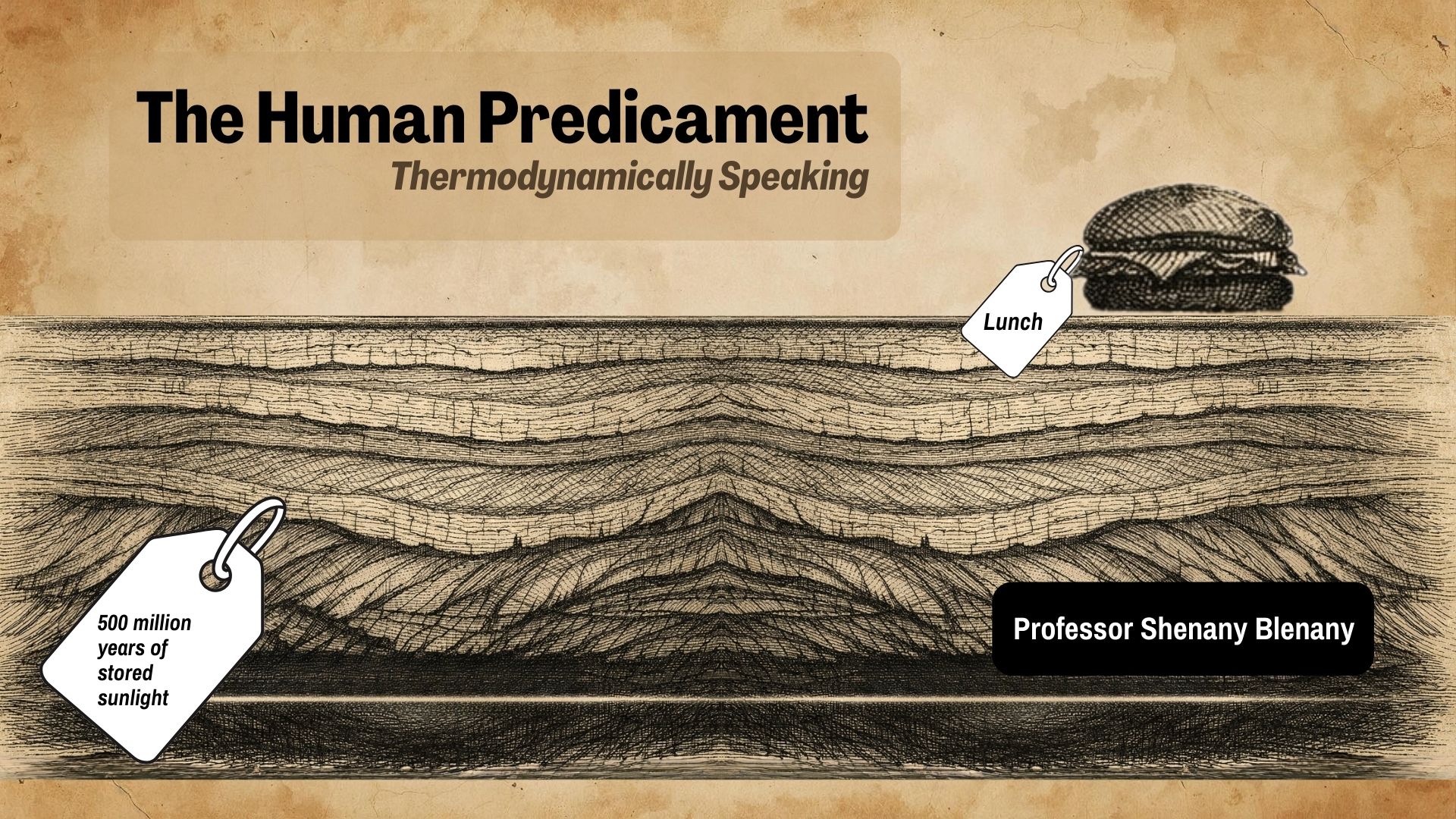
Fossil fuels are not an energy source. They are stored solar energy — photosynthesis from hundreds of millions of years ago, compressed and concentrated by geology. We are burning in two centuries what took half a billion years to accumulate. Smil provides the numbers. Hagens provides the frame. Together they establish the situation: we are not living on income. We are spending inheritance.
The hero chain for this course is not a metaphor. It is a description. Session 2 is where it becomes literal.
3
Living Systems Run on Net Energy
Energy: H.T. Odum, Environment, Power, and Society, selected
Energy: Hall & Klitgaard, Energy and the Wealth of Nations, selected
H.T. Odum spent his career mapping energy flows through living systems. His finding: all systems — cells, ecosystems, economies — are shaped first and last by the energy available to run them. Hall and Klitgaard apply this to economics and find that GDP is, at bottom, a function of energy throughput. This is not a controversial claim in biophysical economics. It is simply not the economics that was taught in most universities.
Unit I Checkpoint
What is one system in your own life you now read differently through the lens of net energy?
4
The Economy Is Not What You Think It Is
Energy: Hagens, The Bottleneck, selected
Complexity: Soddy, Wealth, Virtual Wealth and Debt, selected
The economy is conventionally described as a system of exchange, production, and financial flows. Biophysical economists describe it as a system for capturing and dissipating energy, with money as a claim on future energy use. Frederick Soddy — a Nobel laureate in chemistry who turned to economics — said this clearly in 1926 and was ignored. Hagens updates the argument for the present moment. Session 4 is where the reframe lands hardest.
5
The Superorganism
Energy: Hagens, TGS — superorganism episodes
Complexity: Wilson, The Social Conquest of Earth, selected
Hagens uses the superorganism frame to describe human civilization: billions of individuals behaving as a single energy-dissipating system, coordinated not by intention but by incentive structures that emerged from the same fossil energy surplus that powers everything else. Wilson provides the evolutionary biology of eusociality that makes the comparison precise. Together they explain why no single actor designed the situation and no single actor can exit it.
6
Complexity Has a Price
Complexity: Tainter, The Collapse of Complex Societies, Ch. 1–4
Joseph Tainter's argument is precise and devastating: societies increase in complexity to solve problems, but complexity requires energy to maintain, and the returns on complexity investments decline over time. Eventually the marginal return on complexity drops below the cost of sustaining it. This is the mechanism of collapse — not catastrophe, not invasion, not moral failure, but an accounting problem in the energy ledger. Tainter appears in APMA-115 as a reference. This is his home. Read him in full.
APMA-115 introduces Tainter in Week 9 in the context of network theory and resilience. Here he is primary. If you've read him there, read him again differently: not as a systems theorist but as a historian making a thermodynamic argument.
7
Overshoot
Complexity: Catton, Overshoot, Part I–II
Energy: Meadows, Thinking in Systems, selected
William Catton coined the term "overshoot" to describe what happens when a population exceeds the carrying capacity of its environment by drawing down non-renewable resources. He wrote the book in 1980. Everything he described is now visible in the data. Meadows provides the systems vocabulary for reading overshoot dynamics — the lag between signal and response, the behavior-before-feedback-arrives problem. Catton and Meadows together are the Unit II synthesis.
Unit II Checkpoint
Apply Tainter's complexity cost framework to one institution you participate in.
8
The Mismatch
Blindness: Sapolsky, Behave, selected
Blindness: Kahneman, Thinking, Fast and Slow, selected
If the thermodynamic situation is this clear, why can't we see it? Units I and II described the physical reality. Unit III describes the cognitive and narrative reality: human minds were shaped by evolution for a world of immediate threats and short time horizons. They are not equipped, without deliberate effort, to perceive century-scale processes or exponential dynamics. Sapolsky provides the neuroscience. Kahneman provides the cognitive science. The mismatch is not stupidity. It is architecture.
9
Energy Blindness
Blindness: Hagens, TGS — "Energy Blindness" episodes
Energy: Smil, Energy Myths and Realities, selected
Hagens gives the condition its name: energy blindness. We use energy constantly, depend on it entirely, and perceive almost none of it directly. The food on your plate, the warmth in your house, the data moving through the network — all of it is energy flows made invisible by infrastructure. Smil catalogs the myths that fill the perceptual gap: that renewables will substitute seamlessly, that efficiency gains will close the surplus gap, that the transition is primarily a technology problem. He has the numbers. The myths do not.
10
How Stories Fail at Scale
Blindness: McGilchrist, The Master and His Emissary, selected
Blindness: Solnit, A Paradise Built in Hell, selected
McGilchrist argues that Western culture has systematically amplified left-hemisphere processing — the part of the brain that abstracts, categorizes, and manipulates — at the cost of right-hemisphere processing, which perceives context, wholeness, and relationship. The result is a civilization remarkably good at optimizing components and remarkably bad at reading systems. Solnit offers a different angle: in disasters, humans behave far better than their narratives predict. The stories we tell about human nature are often wrong in ways that matter for how we respond to crisis.
This session connects directly to COGN-120 Unit II. If you haven't taken that course yet, the McGilchrist material will function as a standalone argument. If you have, you will recognize the machinery from inside.
11
The Narrative We're Still Inside
Blindness: Hagens, TGS — selected recent episodes
Complexity: Turchin, Ages of Discord, selected
This session makes the argument that progress — the dominant narrative of the industrial era — is not wrong as a value but wrong as a description of the current trajectory. Turchin's cliodynamics provides a data layer: historical cycles of political instability correlate with resource stress and elite overproduction in ways that are now visible in the present. The narrative we are inside is a complexity-reduction strategy. Unit III ends by naming it as such, without replacing it. That work is Unit IV's.
Unit III Checkpoint
Identify one dominant narrative in your professional or civic life that functions as a complexity-reduction strategy.
12
The Bottleneck
Orientation: Hagens, The Bottleneck
Orientation: Ostrom, Governing the Commons, selected
Hagens uses the bottleneck metaphor for what is coming: a period of significant contraction and reorientation before whatever comes after. Not extinction, not apocalypse — a bottleneck. Ostrom provides the counter-evidence to Hardin's "tragedy of the commons": human communities, given the right conditions, are capable of managing shared resources sustainably over long periods. The conditions matter. They are not guaranteed. They are also not impossible.
13
Islands of Coherence
Orientation: Wheatley, Who Do We Choose to Be?, selected
Orientation: Solnit, Hope in the Dark, selected
Margaret Wheatley's frame: in a time of systemic breakdown, the most useful thing a person can do is create islands of coherence — local practices, communities, and institutions that preserve the things worth preserving and model what functional human systems look like. This is not a small thing. Solnit's argument runs parallel: hope is not optimism. It is the refusal to foreclose possibility. These are practical orientations, not consolations. The difference matters.
14
The Fifth Law
Energy: Odum & Odum, A Prosperous Way Down, selected
Orientation: Selected contemporary degrowth literature
Howard and Elisabeth Odum argued for a "prosperous way down" — a managed, dignified contraction that preserves the best of what industrial civilization produced while releasing what was only possible at peak energy. The fifth principle of thermodynamics, in Odum's framing, is that systems at maximum power also organize to use that power well — and that descent, done consciously, can be organized. This is the most contested session in the course. The contestation is the material.
You are now prepared for the final session. You have the physics, the history, the cognitive science, and the orientation frames. What you do not have is certainty. That is not a failure of the course. It is the honest conclusion.
15
Thermodynamically Speaking
Return: Session 1 prompt, again
Return to Session 1. Same prompt: name one system in your life and describe how it works. Write it without looking at what you wrote in Session 1. Then read them side by side. The course title is the final session title because the course argument is the session argument: the grammar of thermodynamics is not a specialty vocabulary for scientists. It is a description of what is happening, stated plainly, without editorial. You now have it. What you do with it is not thermodynamically determined. That part is yours.
Unit IV Checkpoint
Write the opening paragraph of the course you would build for someone you love who isn't ready to take this one yet.
How This Course Connects
ERTH-201 is Ring 2's thermodynamic anchor. APMA-115 gives you the systems vocabulary; ERTH uses it to read civilization-scale collapse in real time. SB-1972 is the narrative and fiction layer of the same territory — Octavia Butler modeling what ERTH describes in physics. COGN-120 explains why we can't see it clearly.
Assessment
ERTH-201 uses a completion-based assessment model. There are no grades. There is only: did you do the work? The unit checkpoints are the spine. The final is a choice.
Per Session · 40%
Boop Log
One entry per session. What did you read? What landed? Where did you see it outside the text? Not a summary — a report from your own encounter with the material.
Per Unit · 30%
Unit Checkpoint
Each unit ends with a specific application prompt. These are not optional. They are the course's pedagogical core — the place where the abstract becomes personal and the personal becomes legible.
Final · 30%
Your Choice of Three
Option A: 1,500-word essay — one argument the course made that you now believe, stated in your own terms.
Option B: Annotated reading list — ten texts, with a one-paragraph note on each explaining how it connects to the course argument.
Option C: Design a unit — fifteen sessions, a boop thesis, a hero chain. For someone who isn't ready for ERTH-201 yet.
4 Units Complete
Certificate of Completion
Complete all four units and their checkpoints and you have finished the course. A certificate is issued. The work is yours.
Mobocoin Ledger
Boop logs (15 sessions)+15 MC
Unit checkpoints (4 units)+6 MC
Course completion+5 MC
Total Available
26 MC
A Note on AI and This Course
ERTH-201 is about seeing what is actually there. Large language models are very good at producing coherent, confident summaries of complex topics — including the topics in this course. A model-generated summary of Tainter or Catton will sound right. It will also be exactly the kind of narrative-smoothing that Unit III describes as the problem. The boop logs and checkpoint prompts are designed to be un-summarizable: they ask what happened to you when you read, not what the text said. That part cannot be outsourced. The reading cannot be outsourced either. The model hasn't experienced overshoot. You are being asked to.
A Note on This Course
I spent several years in business school environments teaching energy and sustainability in the language those environments understood: ROI, risk management, competitive advantage, stranded assets. I got good at it. I also noticed, over time, that the frame was doing exactly what Unit III describes — functioning as a complexity-reduction strategy that made the material feel manageable and actionable and therefore safe.
ERTH-201 does not use that frame. It uses thermodynamics, which is less comfortable and more honest. The business school version of this material implies that the problem is solvable within existing institutions if the right incentives align. The thermodynamic version implies something different. I prefer the thermodynamic version. Not because it is more hopeful — it isn't, particularly — but because it is more true. And I think people deserve the true version. Especially now.
— Prof. Shenany Blenany · Earth, Energy & Civilization