
Course Introduction

This is not a course about cognitive bias. You've heard that course.

This course starts one level deeper. Your brain does not receive reality — it generates it. Every perception you have is a prediction your nervous system produced and then checked against incoming signal. Most of the time, the signal confirms the prediction and you never notice the machinery running. This course is about what happens when you look at the machinery directly — and what you find when you do.

The Boop · Course Thesis

Your mind isn't making mistakes. It's doing exactly what it was built to do. That's the problem.

COGN-120 · How We Think and Why That's the Problem

About This Course

The Caveat — Stated Upfront

This course will show you that you are wrong in systematic, predictable ways. That is not an insult. It is a description of what cognition is. The same machinery that produces the errors is the machinery that lets you cross a street, recognize a face, fall in love. You cannot remove it. You can learn the terrain.

Moby yelling

ATTN-100 sharpened the instrument. This course examines the instrument itself — not what it looks at, but how it works and where it fails. The answer is stranger than "you have biases." The answer is that the failures are features: fast, coherent, socially functional, and structurally resistant to correction. Knowing this does not fix it. But not knowing it makes you the last to see it operating.

On What This Course Is Not

We will not be compiling a list of 200 cognitive biases, building a rationalist self-improvement program, or asking you to simply "think more carefully." We will be looking at what thinking actually is, why it works the way it does, and what it costs to work that way. Some of what we find will be uncomfortable. The discomfort is data. Notice it.
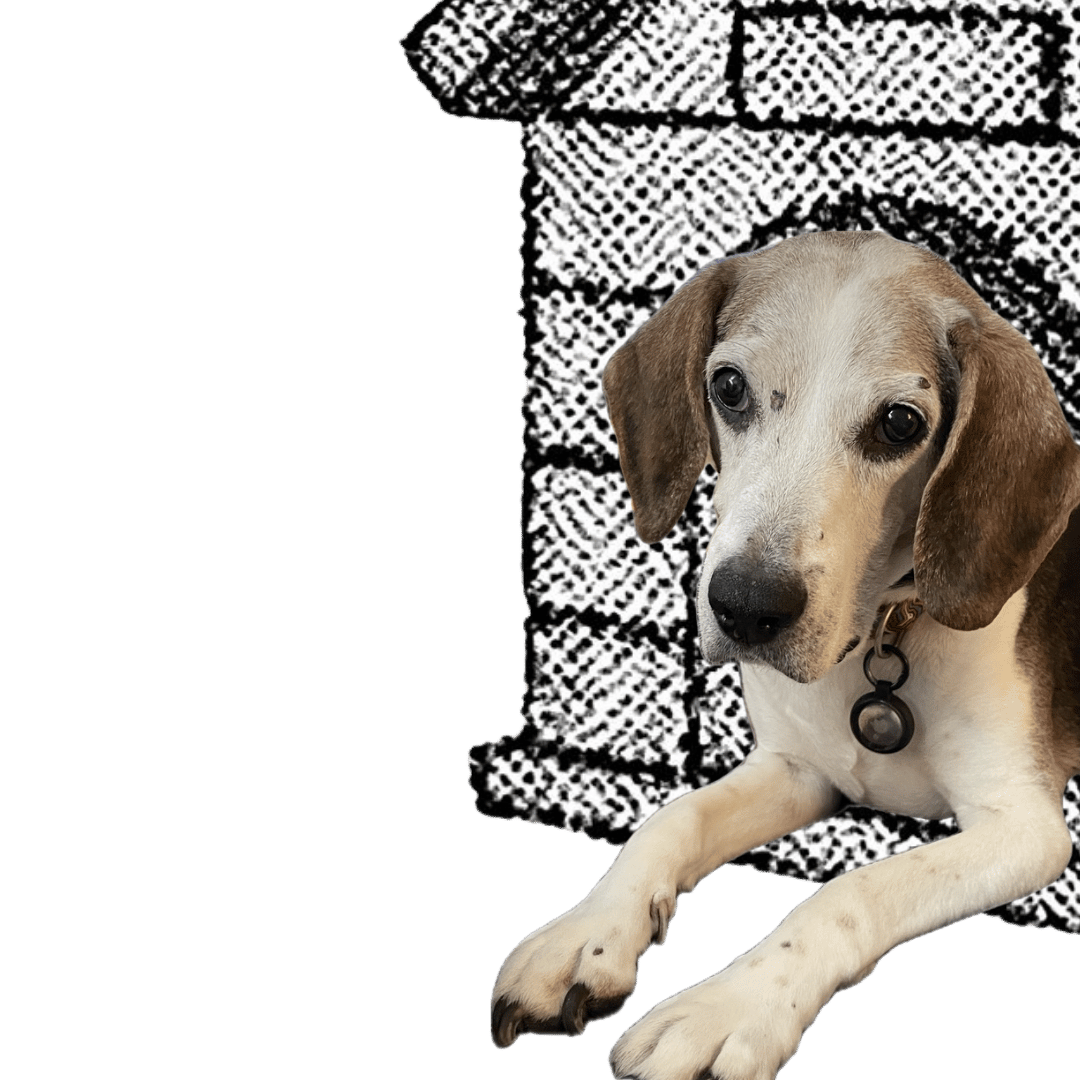
Moby doghouse

The goal is not to produce a list of correctives. The goal is legibility: to be able to read the machinery when it runs in you, and when it runs in public discourse, and not be the last person in the room to notice what's happening.

Syllabus

UNIT I The Constructed World 5 sessions
1
A Report. Then a Reckoning.
Practice: ATTN-100-style observation report
If you've completed ATTN-100, you know how to do this. Pick one: spend 20 minutes drawing something in the room, or sit outside and describe exactly what you hear, or spend 10 minutes with one object. Report what is there. No analysis. Then: bring your report back in Session 2 and we will show you what the machinery added without your permission.
The gap between what you reported carefully and what was actually there — that gap is the course.
2
The Prediction Machine
Anchor: Clark, Surfing Uncertainty, selected Reading: Anil Seth, Being You, Ch. 1–3 Practice: return to Session 1 report — find the predictions
Your brain is not a camera. It is a prediction engine that generates a model of the world and updates it when the signal doesn't match. Most of what you perceive is the model, not the world. This session names what happened in Session 1: the "report" you wrote was already full of predictions your nervous system inserted before you noticed. Find three of them in your own writing.
3
What Gets Through
Reading: Kahneman, Thinking, Fast and Slow, Part I Practice: catch one System 1 conclusion today before System 2 ratifies it
Kahneman's System 1 / System 2 distinction is the entry point — not as the destination but as vocabulary. Fast automatic processing handles most of cognition; slow deliberate reasoning is rare, costly, and often recruited to justify conclusions already reached. The practice: notice once today when you arrived at a conclusion before you reasoned your way there. Write it down before you explain it away.
4
The Body Knows First
Anchor: Damasio, Descartes' Error, selected Practice: one somatic decision — notice what your body did before your reasoning started
Damasio's somatic marker hypothesis: the body processes evaluative information before conscious reasoning begins. Emotion is not interference with cognition — it is a component of it. Patients with damage to emotional processing centers don't become more rational; they become unable to decide. The construction of reality includes the body, and the body has already voted before the argument begins.
This is the ATTN-100 session 4 thread returned, but at a different level. Menakem told you your body holds history. Damasio tells you your body holds reasoning. They are not the same claim. Note the difference.
5
Consolidation: What Kind of Thing Are You?
Practice: one paragraph — what did you expect this course would tell you that it hasn't told you yet?
Not a summary. A report on what landed and what didn't. What surprised you about the predictive processing frame? What felt like something you already knew stated more precisely? What are you still resisting? The expectation you had about this course is itself a prediction — examine it. The unit ends here before the errors begin, because you need to know what the machinery is before you see it malfunction.
UNIT II Why You Are Wrong 5 sessions
6
The Coherence Drive
Anchor: Kahneman, Thinking, Fast and Slow, Part II–III Practice: find one belief you hold because it fits a pattern, not because you tested it
Confirmation bias, anchoring, availability, narrative fallacy — these are not random errors. They are all expressions of the same underlying drive: the brain optimizes for coherence and speed, not accuracy. A coherent story feels true even when it isn't. The practice asks you to find one belief that is doing coherence work — not a belief you're wrong about necessarily, but one you've never stress-tested because it sits so naturally in the pattern of everything else you believe.
7
The Argumentative Animal
Anchor: Mercier & Sperber, The Enigma of Reason, selected Practice: find one argument you made recently that was construction, not inquiry
Mercier and Sperber's thesis is more disturbing than Kahneman's. They argue that reasoning did not evolve to find truth — it evolved to win arguments and manage social standing. Motivated reasoning is not a malfunction. It is reasoning doing its actual evolved job. We are not bad reasoners who sometimes reason well. We are social animals who use reason instrumentally and call it thinking. The practice: find an argument you made in the last week. Was it inquiry — genuinely open to where it led? Or was it construction — building a case for a conclusion you'd already reached?
Notice: this is a different claim than Session 6. Session 6 said the errors come from optimizing for coherence. This session says some errors are features optimizing for something else entirely. Both are true. They point in different directions. Stay in that.
8
The Group Mind
Reading: Haidt, The Righteous Mind, selected Practice: identify one belief where you cannot tell whether it's yours or your group's
Haidt extends Mercier and Sperber into the social dimension: moral reasoning is largely post-hoc rationalization of intuitions shaped by group membership. Your in-group is not just a social fact — it is a cognitive fact. It shapes what evidence you encounter, what conclusions feel plausible, and what reasoning feels compelling. The practice is genuinely hard: find a belief where you cannot cleanly separate what you think from what your people think. If you can't find one, that's the most interesting data.
9
Holding Two Models
Tension: Kahneman vs. Mercier & Sperber Practice: apply both frames to one belief from your Session 6 or 7 practice
This session does not resolve the tension between the coherence story and the argumentative story. It asks you to sit in it. Take one belief from your Session 6 or 7 practice. Explain it using Kahneman's frame: a coherence error, an availability heuristic, a narrative the brain found faster than the truth. Now explain the same belief using Mercier and Sperber's frame: motivated reasoning, social function, instrumental use of argument. Both explanations fit. Neither fully wins. What do you do with that? The discomfort you feel right now — that is the course's central subject.
Holding two models without collapsing into one is not indecisiveness. It is a cognitive skill. You are practicing it now for the first time. Notice what it costs.
10
The Machinery in the Wild
Reading: selected current examples — media, politics, everyday discourse Practice: find one public argument and run both frames on it
The same machinery you've been examining in yourself operates at scale in public discourse. This session takes the cognitive frames out into the world: find a recent public argument — a news story, a political position, a social media exchange — and apply both the coherence frame and the argumentative frame. Not to debunk it. Not to assign blame. To read it. The goal is legibility, not superiority. You are practicing a skill that will matter in every course that follows.
UNIT III What You Do With That 5 sessions
11
The Honest Answer About Debiasing
Reading: Kahneman on debiasing; Lilienfeld et al. on limits of bias reduction
Here is what the research actually says: knowing about your biases does not reliably reduce them. Kahneman said this himself, repeatedly. The debiasing literature is thin and the effect sizes are small. This session does not hide that. If COGN-120 told you that understanding cognitive science makes you a better thinker, it would be lying by exactly the mechanism it just taught you — telling you a coherent story that feels satisfying. The honest answer is: knowing the terrain helps, but less than you want it to, and differently than you expect.
Notice what you feel reading that. The desire for the course to be more useful than it is — that desire is also the machinery running.
12
Calibrated Uncertainty
Anchor: Philip Tetlock, Superforecasting, selected Practice: make three predictions with explicit probability estimates. Write your reasoning.
Tetlock's superforecasters are not less biased than ordinary people — they are better at tracking the difference between confidence and accuracy. The skill is not bias elimination. It is calibration: knowing when your certainty is warranted and when it is the coherence machinery talking. The practice is specific: make three concrete predictions about things you care about. Assign probabilities. Write the reasoning. Return in Session 14 and see what happened. Not to be right — to see how you reason.
13
The Steel Man
Practice: steel man a position you find genuinely wrong
Not the straw man — the strongest possible version of a position you disagree with. This is harder than it sounds. Your coherence machinery will keep defaulting to a version you can defeat. The test: could someone who holds this position read your steel man and say "yes, that's what I actually think"? If not, try again. This is not a sympathy exercise. It is a precision exercise. You are learning to see the machinery in the other direction — the way your in-group reasoning shapes what you let the opposition say.
This practice is the direct bridge to PHIL-110. Argumentation requires knowing what you're actually arguing against. COGN-120 gives you the reason why that's hard. PHIL-110 gives you the tools anyway.
14
Return to Session 12
Practice: revisit your three predictions — examine the reasoning, not the outcomes
Return to the predictions you made in Session 12. Some may have resolved; some may not have. That's fine — the outcomes are not the point. The point is your reasoning: look at what you wrote about why you believed what you believed. Where was the coherence drive operating? Where was motivated reasoning? Can you see it now that you couldn't then? The before/after is not about being right. It is about whether the machinery is becoming visible.
15
Return
Anchor: Wittgenstein, On Certainty, selected passages Practice: Session 1 prompt, again
Return to Session 1. Same object, same prompt, same instruction: report what is there. Write it. Then read your Session 1 report next to your Session 15 report. Do not summarize the course. Do not evaluate your own growth. Just look at the two reports. The difference between them — what you can name now that you couldn't name before, what you notice the machinery doing that you couldn't see before — that is the course. Wittgenstein: "At the foundation of well-founded belief lies belief that is not founded." You can learn the terrain. You cannot get outside it. Go do the work that is left.
This course ends where PHIL-110 begins. The external scaffolding — logic, argument structure, evidence standards — is what compensates for what knowing the terrain alone cannot fix. You are ready for it now.

How This Course Connects

COGN-120 sits between ATTN-100 and PHIL-110 in Ring 0. ATTN-100 trained the instrument. This course examines why the instrument fails — structurally, predictably, and in ways that resist simple correction. PHIL-110 takes the next step: here is the external scaffolding that compensates for what internal self-knowledge alone cannot fix.

Assessment

Per Session

Boop Log

One entry per session. Report, not analysis. What did you notice? Where did you see it outside the session?

Per Unit

Unit Response

One belief, one practice, one observation — and what it did. Two pages max. Not a survey of the unit. The thing that landed, followed all the way down.

Session 15

Return

Same prompt as Session 1. Informal. Kept by the student. Not submitted, not graded.

3 Units

Certificate of Completion

Complete all three units and you've finished the course. A certificate is issued. Moby approved this.

Mobocoin Ledger

Mobocoin
Earn MC for completing this course.
Learn how Mobocoin works →
Boop logs (15 sessions)+15 MC
Unit responses (3 units)+6 MC
Course completion+5 MC
Total Available 26 MC
Faculty

Character TBD. Persona: someone who has spent a career studying how minds fail and has arrived at a position of deep, unsentimental warmth toward human cognitive limitation — not because the failures don't matter, but because they are universal and structural and therefore nothing to be ashamed of. Drily precise. Allergic to self-help framing. Practices calibration as a daily habit and talks about it the way a woodworker talks about knowing their tools. Name and character built in the faculty pass after Ring 0 is designed.

— Faculty TBD · Institute for Mind and Epistemology