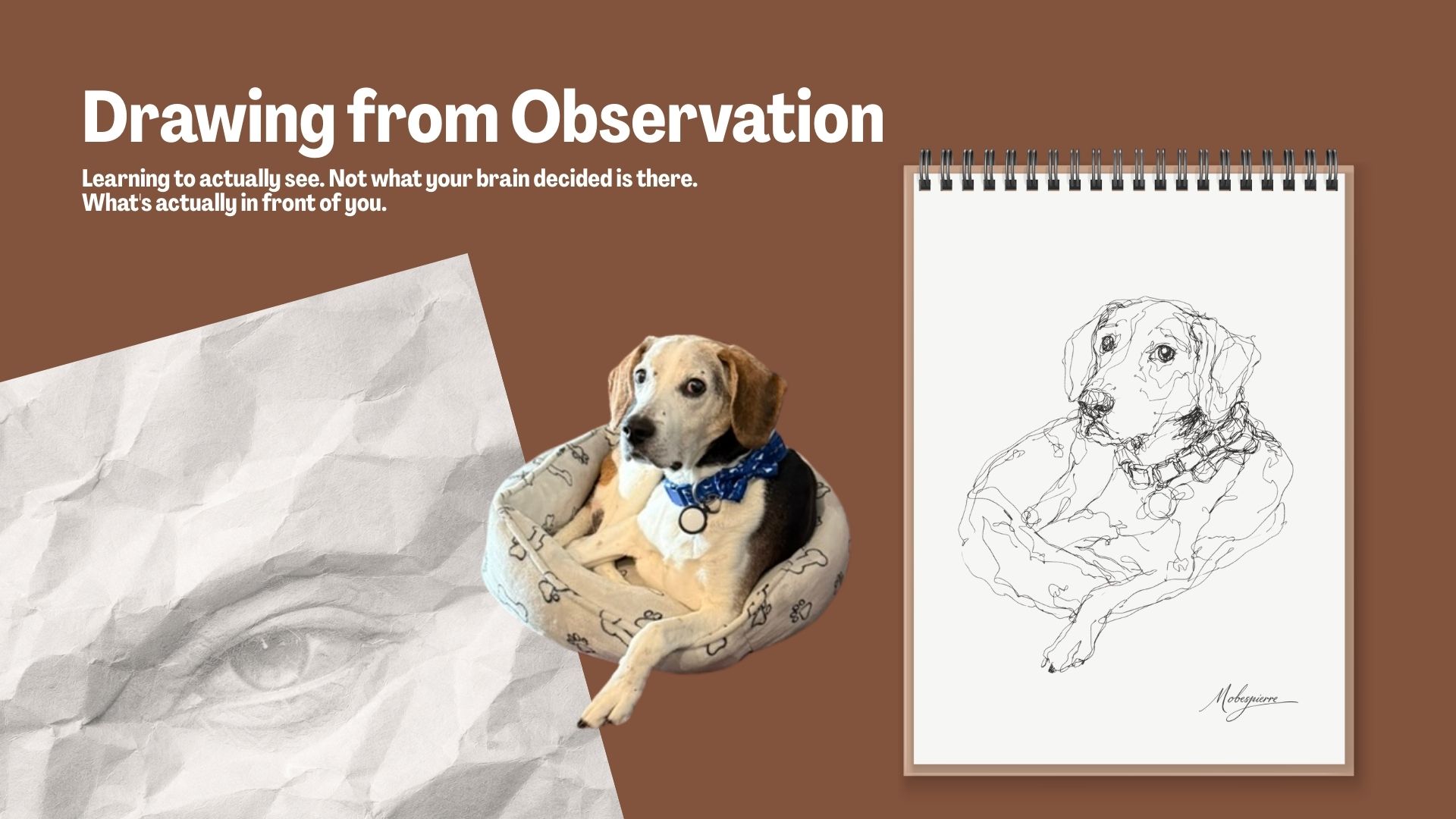
Course Introduction
Ask a student to draw a hand. Then ask: what did you draw?
The answer, almost always, is the symbol for a hand. Not the hand. The brain is ruthlessly efficient: it substitutes the known for the seen, the category for the thing. You stop looking at the hand and draw the idea of one. This course is about the gap between what you see and what you know — and what happens when you learn to close it. Not through talent. Through practice. Thirty minutes a day, a sketchbook, and the slow discipline of actually looking at what's in front of you.
The Boop · Course Thesis
The problem isn't their hand. It's their eye.
VIS-101 · Drawing from Observation
About This Course
No Prior Drawing Experience Required
You need a sketchbook and the willingness to be a beginner. The beginner's eye, it turns out, is the whole point. People who already believe they can draw are often harder to teach than people who know they can't — because the symbol-substitution habit is deeper and more confident. Start from nothing. That's the better starting position.
Most people believe they can't draw. What they actually mean is that when they try, the result doesn't look right. They're correct that something is wrong — but they're wrong about what it is. The problem isn't motor skill. It's perception. The brain sees a hand, says "I know what a hand looks like," and the eye stops working. The hand draws the memory instead of the thing.
By the end of fifteen sessions, you will draw better. More importantly, you will see better. And that turns out to matter for everything else — for how you read an argument, how you notice what's actually happening in a room, how you catch yourself making assumptions about things you haven't looked at. This is not a decorative skill. It's an epistemic one.
On the Daily Practice
The sketchbook is not a homework assignment. It's the course. Everything else is commentary. Thirty minutes minimum per day, beginning Session 1, Day 1. This is non-negotiable — not because we're being strict, but because the practice only builds if it's daily. A sketchbook completed five minutes before the session is not a sketchbook. It's a document that the practice didn't happen.
How This Connects to Ring 0
Every course in Year One catches your brain in a different lie. ATTN-100 catches it about what you can actually perceive when you're not filtering. COGN-120 catches it about how the machinery of mind systematically fails. VIS-101 catches it about the physical world — the gap between what's in front of you and what your brain decided is there. The sketchbook is the lab notebook for the rest of Year One.
Syllabus
1
The Symbol vs. The Thing
Eye: symbol-substitution
Hand: first drawing
Reading: Edwards, intro + Ch. 1 · Berger, Ways of Seeing, Ch. 1
First drawing: your non-dominant hand. Don't erase. Don't stop. The goal is not to get it right — it's to record exactly what your eye moves across when it follows the real thing. Afterward: what did you draw? Compare the drawing to the hand. Most people draw the symbol they carry for "hand" — the cartoon version, the logo. That's the starting position. The gap between what you drew and what's actually there is what the course is about.
Keep this drawing. You'll return to it in Session 15.
2
Contour Drawing — Following the Edge
Eye: edge-tracking
Hand: blind contour
Reading: Edwards, Ch. 4
Draw without looking at the paper. Your eye moves slowly along the edge of the subject; your hand follows. The results look wrong. That's fine — wrong by the brain's standards means right by the eye's. Blind contour breaks the symbol-substitution habit more effectively than anything else in the course, because it forces the eye to keep moving across the actual surface rather than jumping to the mental shortcut. Five drawings minimum this session. The uglier, the better.
3
Negative Space — Drawing What Isn't There
Eye: figure/ground reversal
Hand: drawing the air
Reading: Edwards, Ch. 7
The shape of the space around an object is as specific and drawable as the object itself. This session you draw only the negative spaces — the holes, gaps, and air around and between things. The brain resists this because it has no symbol for "the space to the left of the chair leg." That resistance is exactly why the exercise works. First: draw three negative spaces from one ordinary object.
4
Value and Light — Not Outlines, But Gradients
Eye: light as information
Hand: shading, no outlines
Reading: Edwards, Ch. 9 · Sacks, The Mind's Eye, Ch. 1
Objects exist in three dimensions because of how light falls on them. This session you add value — the scale from darkest dark to lightest light — to your drawings. Set a single light source: a lamp, a window. Draw the same object, then move the light. The object doesn't change. Everything about how it reads changes. The brain wants to draw outlines. Light doesn't have outlines. Work against the preference.
5
The 30-Minute Sketchbook — Beginning the Daily Practice
Practice: daily sketchbook formally begins
Hand: sustained drawing — one hour, one subject
Reading: Kleon, Steal Like an Artist — read it whole
The daily practice has been running since Session 1. This session names it formally and anchors it. Pick three objects you own — not beautiful ones, familiar ones. Arrange them. Draw them for a full hour without abandoning the drawing. The goal is sustained, specific attention. What do you notice at minute forty that you missed in minute five? What came back? The sketchbook is not producing drawings. It's training an eye. The drawings are evidence the eye was working.
Unit I checkpoint: Before your next three meals, spend two minutes drawing one object on the table. Don't finish the drawing. Just start it. What do you notice that you would have missed?
6
Drawing from Memory vs. Drawing from Life
Eye: memory vs. observation
Hand: parallel drawings
Draw the same object twice: first from memory (don't look at it), then from life. Put them side by side. The memory drawing reveals your symbol — what you carry for this object. The life drawing reveals what's actually there. The distance between the two is a precise measurement of how much your brain was substituting for your eye. Do this with five different objects over the week. Find the objects where the gap is biggest. Those are the objects your brain has the most confident, most inaccurate story about.
7
The Moving Subject — What to Do When It Won't Hold Still
Eye: gesture and energy
Hand: 30-second gesture drawings
Reading: Nicolaïdes, The Natural Way to Draw — gesture chapter
Gesture drawing captures movement and energy, not outline. Thirty seconds per pose. You're not drawing what something looks like — you're drawing how it feels to be arranged that way: the weight, the tension, the collapse. The dog, the person on the bus, the child mid-fall. When the subject moves, you commit to what you saw rather than what's still there. Commitment to a vanished moment is a different skill than careful rendering — and it teaches something the still object can't.
8
Proportion and Relationship — How Parts Imply Each Other
Eye: comparative measurement
Hand: pencil-as-ruler
Reading: Edwards, Ch. 8
Proportion is where the brain is most aggressively wrong. Eyes are halfway down the face, not two-thirds up. Hands are enormous relative to forearms. This session you measure: use your pencil as a ruler. Hold it at arm's length, close one eye, and compare what you measure to what you assumed. Write down three things you measured this session that turned out completely different from your expectation. Then draw them at the correct proportion even though it looks wrong. This is one of the stranger experiences in the course — drawing what you measured rather than what you believe.
9
Composition as Argument — What You Include and Exclude
Eye: framing as choice
Hand: sustained scene — 90 minutes
Reading: Berger, Ways of Seeing, Ch. 2 — on what gets selected and what doesn't
One room, drawn in full. Not a sketch — a sustained observation. Chairs, a table, the window, whatever's there. Work from life for at least ninety minutes. Before you draw, make a framing decision: what's in, what's out, where does the page edge cut. That decision is an argument. What you include implies what matters; what you exclude implies what doesn't. Composition is not arrangement — it's editorial. Berger is on this session's reading list because the question of what gets selected is older than photography.
10
Failure as Data — What a Bad Drawing Tells You
Eye: reading the drawing's errors
Hand: failed drawing analysis
Pick a drawing from your sketchbook that felt like a failure. Not a drawing you gave up on — one you finished and didn't like. Describe what the drawing got wrong. Then: describe what it got right by accident. A bad drawing is not evidence that practice isn't working. It's a precise readout of where the eye stopped trusting itself, where the brain took over, where you started drawing the symbol again. Every error has a specific cause. Finding that cause is the work of this session.
Unit II checkpoint: Pick a 10-minute drawing from this unit that felt like a failure. Describe what it got wrong — and what it got right by accident.
11
Attention as Epistemology — Thirty Minutes a Day as a Knowledge Practice
Eye: perception as knowing
Practice: the sketchbook as a way of knowing, not just recording
Reading: cross-link to ATTN-100, Session 1
Thirty minutes a day with a sketchbook turns out to be one of the most rigorous epistemological practices available. Not because drawing is sophisticated — because sustained, accountable attention to the physical world is rare, and rarity makes it powerful. This session asks: what do you now know about attention that you didn't know in Session 1? ATTN-100 trained the instrument generally. VIS-101 trained it on the specific problem of the gap between seeing and knowing. The sketchbook is not a record of what you drew. It's a record of what you were willing to look at long enough to be wrong about.
12
The Sketchbook as Thinking Tool — Drawing as a Mode of Inquiry
Practice: draw a problem you're trying to solve
Reading: Kleon, Show Your Work — on documenting process
Scientists, architects, and designers use drawing to think, not to illustrate thoughts they've already had. The sketchbook becomes a thinking tool when you use it before you know what you're trying to say — when the drawing is part of the process of figuring out, not the output of a process already complete. This session: draw something you're trying to understand. A relationship between things. A problem. A space. Not to produce a good drawing — to see if drawing helps you see it differently.
13
Observation in Other Fields — What Scientists, Architects, Detectives Do
Eye: trained observation across disciplines
Practice: one observation exercise borrowed from another field
Medical students are trained to draw what they observe through a microscope before they're trained to interpret it. Architects sketch to understand a space before they design it. Detectives describe a scene before they theorize about what happened. Field naturalists draw specimens to force a second, slower look at what's actually there. In each case, drawing is a tool for forcing the eye to stay with the thing longer than it would if you were only looking. This session borrows one observation practice from a field other than art. The practice itself is the deliverable.
14
What You've Learned to Notice That You Couldn't Before
Eye: tracking change in perception
Practice: review the full sketchbook
Review your sketchbook from Session 1 forward. You're not evaluating quality. You're tracking attention: what subjects kept reappearing? Where did you rush? Where did you slow down? What are you drawing now that you couldn't have drawn in Week 1 — not because your hand is better, but because your eye is willing to stay longer? The sketchbook is a record of what you chose to look at. What does it say about what you've learned to notice?
Unit III checkpoint: "Thirty minutes a day with a sketchbook turns out to be one of the most rigorous epistemological practices available." Do you believe this now? Write the honest answer.
15
Return to Start: Draw the Same Hand from Session 1. Not Better — Differently.
Eye: Session 1 prompt, again
Hand: same subject, different observer
Practice: Session 1 drawing returned
Return to Session 1. Same subject — your non-dominant hand. Same instruction: draw it without stopping, without erasing. When you're done, place the two drawings side by side. Do not summarize the course. Do not evaluate your improvement. Look at the two drawings. What changed is not skill — it's what the eye was willing to do. The drawing from Session 1 shows what you knew. The drawing from Session 15 shows what you looked at. The difference between them is the course. No summary needed.
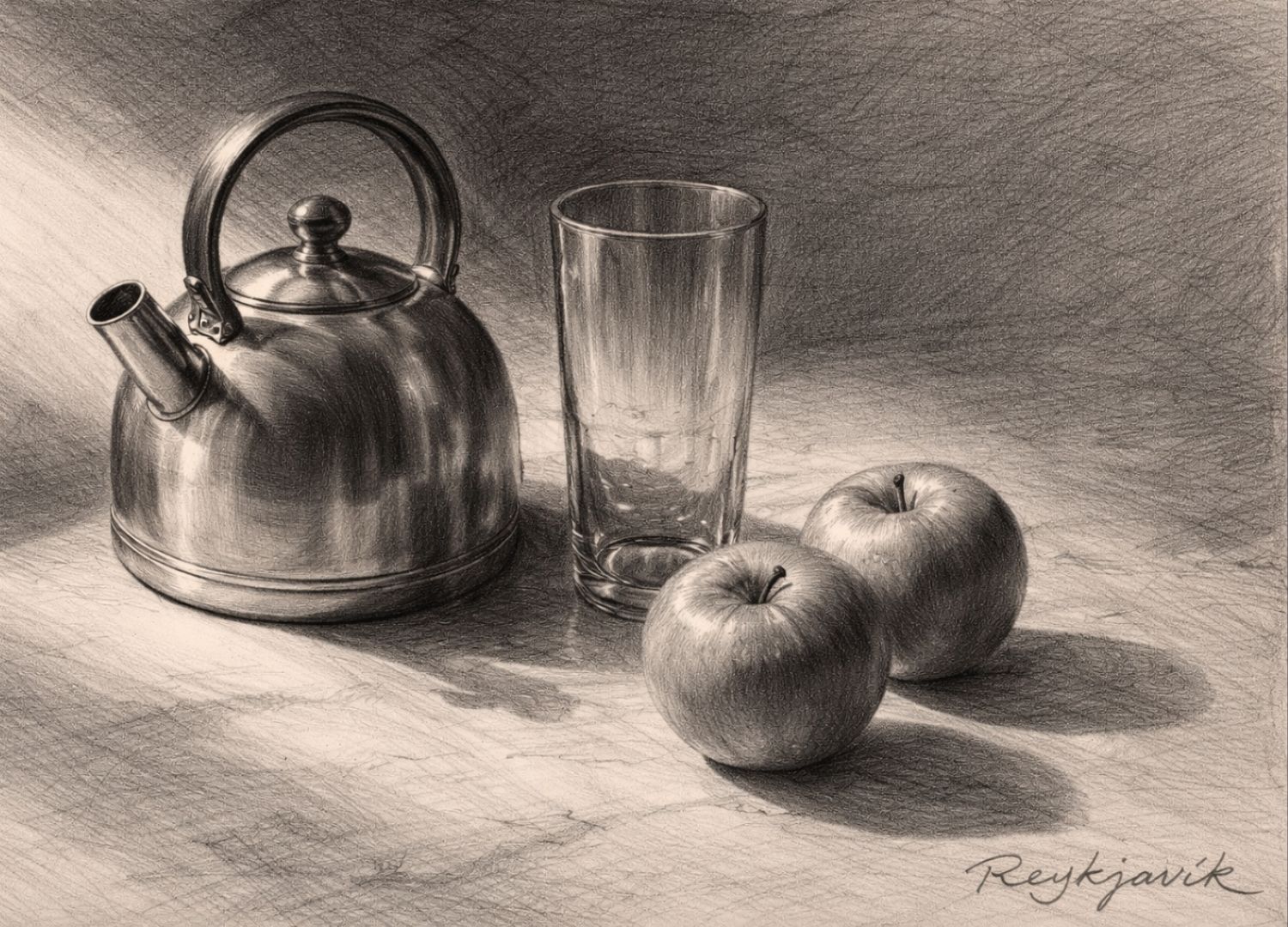
Prompt: "hyper-realistic graphite still life, three household objects, dramatic raking light from upper left, art school chiaroscuro, 2H pencil texture, slight smudging on shadow edges, signed in the lower right corner by an artist named after a European city." Generated in approximately 4 seconds. You would have a file, not an eye.
How This Course Connects
VIS-101 trains the eye the same way COGN-120 trains the mind and POLS-101 trains the political ear. All three work by making the invisible visible. ATTN-100 develops the instrument that all of them use. Drawing from observation is that instrument applied to the physical world — pattern recognition made physical, attention made accountable.
Assessment
On using AI in this course
Drawing is what AI produces the output of. It is not the practice. The hour at the sketchbook — the decisions about line weight, where to look longer, what to leave out — is the assignment. The result is evidence that the practice happened. An AI-generated image is evidence that it didn't. Use whatever tools you want. Just know that submitting the output is submitting proof of absence.
Per Session
Boop Log
One sketchbook entry per session. Not evaluated for drawing quality — evaluated for whether the eye was working. What did you actually look at?
Per Unit
Unit Checkpoint
One short response per unit, written or drawn. The prompts are in the syllabus at the end of Sessions 5, 10, and 14. They ask for a specific observation, not a summary of the unit.
Session 15
Return
Same prompt as Session 1. Draw the hand again. Place the two drawings side by side. Kept by the student. Not submitted, not graded.
3 Units
Certificate of Completion
Complete all three units and you've finished the course. A certificate is issued. The question it answers: what did you learn to see?
Mobocoin Ledger
Boop logs (15 sessions)+15 MC
Unit checkpoints (3 units)+6 MC
Course completion+5 MC
Total Available
26 MC
Faculty
Character TBD. Persona: someone who has spent a long time teaching people to draw and arrived at the position that drawing is almost entirely a perceptual problem, not a motor one — and that this insight, properly understood, opens something much larger than a studio skill. Unsentimental about talent. Deeply patient with the eye. Probably carries a sketchbook. Slightly impatient with people who treat the sketchbook as an aesthetic object rather than a working tool. Name and character built in the faculty pass after Ring 1 is designed.
— Faculty TBD · Studio Arts · BoopUniversity